How Therapists Earn With an AI Avatar — The Economics, Stated Plainly
AI for Inner Explorers.
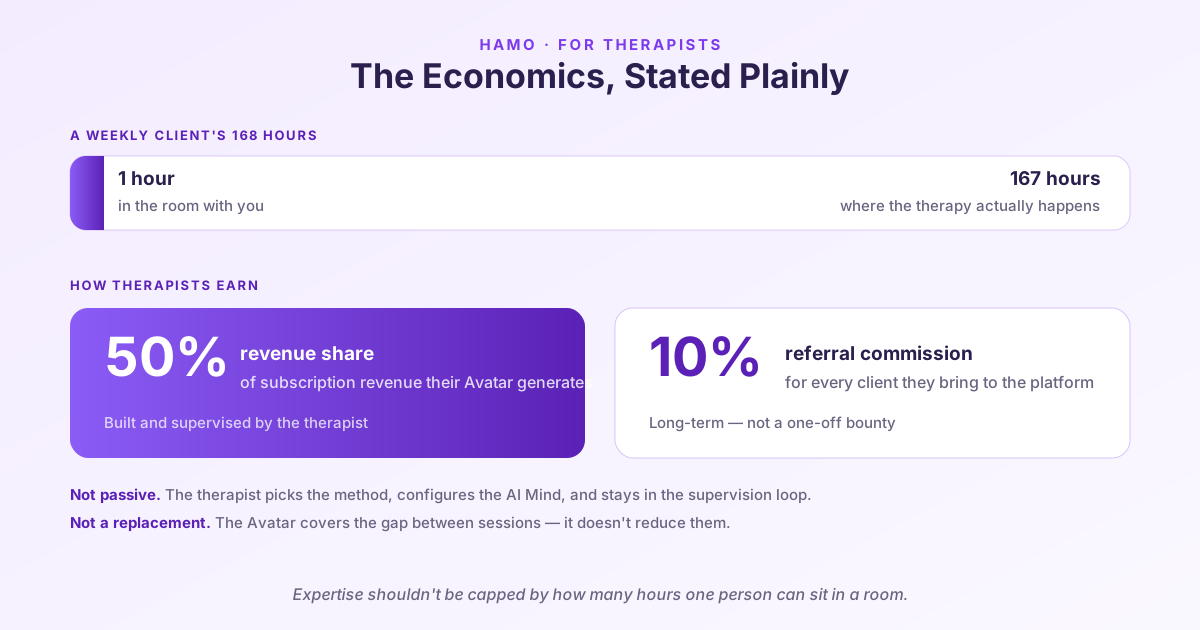
Therapists on Hamo Pro build an Avatar that carries their voice and method, and receive a 50% share of the subscription revenue their Avatar generates, plus a 10% long-term referral commission for every client they bring. It's leverage on clinical expertise — not passive income, and not a replacement for sessions.
The economics of private practice have one hard constraint: a therapist can only be in one room at a time. Everything else — reputation, waitlist, skill — eventually runs into that wall.
The 167-hour problem
A weekly client spends 1 hour with their therapist and 167 hours without one. The clinical work happens in that gap: the 2am spiral, the argument on Tuesday, the thought that came back on the drive home.
Historically a practice could only serve that gap by adding more hours — which is the one input a therapist can't manufacture. The Avatar is a different lever entirely: it extends a specific therapist's framework into those 167 hours, without asking that therapist to be awake for them.
How the revenue model works
Two components, both stated publicly since our second preview webinar:
50% revenue share. A therapist receives half the subscription revenue generated by clients using the Avatar they built and supervise. The split reflects what the therapist actually supplies — the clinical framework, the method selection, the ongoing supervision — versus what the platform supplies: infrastructure, compliance, crisis engineering, and support.
10% long-term referral commission. For every client a therapist brings to the platform, they receive an ongoing 10% commission — long-term, not a one-time bounty.
Because an Avatar isn't hour-capped, its revenue doesn't scale with the therapist's calendar. It scales with how many clients the therapist's framework can serve well — a very different curve.
What this is not
We'd rather set the expectation correctly than sell a fantasy.
It's not passive. The therapist selects the therapeutic method from nine evidence-based options, configures the AI Mind that defines the clinical framework, receives crisis escalations, and reviews client insight. An Avatar left unsupervised isn't a product we want to exist.
It's not a session replacement. The Avatar is built to sustain continuity between sessions, not to reduce them. Clients who feel held between appointments tend to stay in care longer — which is good clinically and, not incidentally, good economically.
It's not autonomous care. The Avatar can't choose its own techniques. In Therapist Mode, deterministic code decides which clinical actions are admissible; the model only reads state and writes wording. When something exceeds what an AI should hold, it escalates to the named supervising therapist through email and a real-time dashboard alert.
What the therapist actually supplies
The reason a Hamo Avatar isn't interchangeable with a generic chatbot is that a licensed clinician's judgment is compiled into it:
- Method selection — which of the nine therapeutic approaches fits this practice's clients
- The AI Mind — the clinical framework the Avatar reasons inside, never outside
- Voice and stance — how this particular therapist meets people
- Ongoing supervision — crisis acknowledgment and clinical review
That's expertise, not labor. It's the one thing a platform can't manufacture — and the reason the split is 50/50 rather than a licensing fee.
Who this fits
Therapists whose waitlist is longer than their calendar. Practices where clients keep hitting the between-session gap. Clinicians who want their approach to reach past the hour without diluting it into generic advice.
If that's the practice, the demo walks through building an Avatar end to end — creation, AI Mind configuration, client onboarding, and supervision.
“A therapist's expertise shouldn't be capped by how many hours they can physically sit in a room. We built the revenue share at 50% because the clinical framework is the product — we're just the infrastructure that carries it into the hours they can't be there.”
— Chris Cheng, Founder and CEO of Hamo AI
Grounded in code, not slideware.
Hamo AI — making minds aware, and awake.
About Hamo AI
Hamo AI Technology Ltd. is a Canada-based artificial intelligence company building next-generation AI-Powered Therapist Avatar System. We are developing a comprehensive AI therapy platform called “Hamo” that connects mental health professionals with clients through AI-powered therapy avatars. The ecosystem consists of three interconnected applications: Hamo Pro (therapist dashboard for creating and managing AI avatars), Hamo Client (client interface for interacting with therapy avatars), and Hamo-UME (Unified Mind Engine, backend API). The platform aims to make mental health support more accessible while maintaining professional oversight through professional therapists who create and manage the AI avatars.
Media Contact
Hamo AI Technology Ltd.
Email: socialmedia@hamo.ai
Website: www.hamo.ai
Address: 108 College St, Schwartz Reisman Campus, SUITE W640, Toronto ON M5G 0C6, Canada
Frequently Asked Questions
How do therapists make money with an AI Avatar on Hamo?
Therapists receive a 50% share of the subscription revenue generated by clients using the Avatar they built and supervise, plus a 10% long-term referral commission for every client they bring to the platform.
Is Hamo Pro passive income for therapists?
Not passive in the hands-off sense. The therapist configures the Avatar's therapeutic method and clinical framework, and stays in the supervision loop — receiving crisis escalations and reviewing client insight. It's leverage on clinical expertise, not an absentee revenue stream.
Does an AI Avatar replace a therapist's sessions?
No. The Avatar covers the gaps between sessions — the roughly 167 hours a week a client isn't in the room. It's designed to sustain continuity of care, not to substitute for the therapeutic relationship or reduce session volume.
What does a therapist have to do to set up an Avatar?
Select the therapeutic method from nine evidence-based options, configure the AI Mind that defines the clinical framework, and set the Avatar's voice and presentation. The clinical decisions stay with the therapist; the platform handles the engineering.
Who is liable for what the AI Avatar says to a client?
The Avatar operates inside the clinical framework its supervising therapist configured, with deterministic gating so it can't choose techniques on its own. Crisis events escalate to that named therapist. Hamo AI is explicitly not a medical device or an emergency service.
How many clients can one Avatar support?
An Avatar isn't capped by hours the way a practice is — it can hold continuous conversations with many clients simultaneously. The practical limit is the therapist's capacity to supervise, not the AI's capacity to respond.