Nine Therapeutic Methods, One Clinical Spine
AI for Inner Explorers.
Companion to Inner Explorer, Awakening Full Awareness.
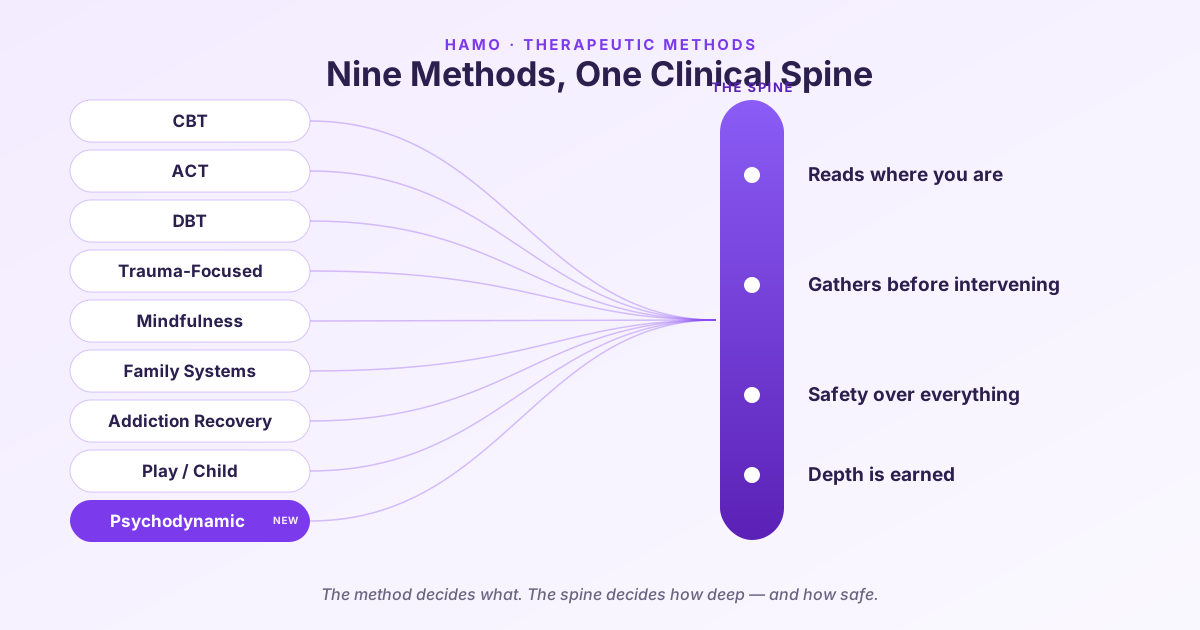
Hamo AI supports nine evidence-based therapeutic methods — from CBT to a newly released psychodynamically-informed exploration — each selected by a licensed therapist, with depth, pacing, and safety governed by one shared clinical spine that the AI model never controls.
Ask most AI companions what kind of therapy they do, and the honest answer is "whatever the conversation drifts toward." Hamo's answer is different — and specific. Hamo practices nine evidence-based therapeutic methods, each selected by the therapist who builds the Avatar, from Cognitive Behavioral Therapy to a newly released Psychodynamically-Informed Supportive Exploration.
But the method a therapist selects only decides what clinical work is on the table. How deep to go, how to speak, how fast to move, and whether it's even safe to go there — those are decided by something underneath every method: one shared clinical spine. That spine is what keeps range from becoming recklessness.
Here's the full picture — the spine first, then all nine methods, a side-by-side comparison, and finally how Hamo matches a method to what a person actually needs.
One spine under every method
Whichever method an Avatar runs, every reply passes through the same shared layer before a technique is ever applied. The method owns the clinical content; the spine owns depth, tone, pace, and safety. A few principles capture how it works — without the engine-room detail (for that, see Taking the Clinical Decision Out of the LLM).
It reads where you are, every message. Each thing you say is assessed in real time and sorted into how much depth is appropriate right now — from simply steadying the ground, to gentle guidance, to deeper working-through. The deeper work only opens when you're regulated enough for it. The same method that explores freely on a calm day pulls all the way back to grounding on a hard one.
It gathers before it intervenes. Before any technique, Hamo establishes the concrete situation in your own words — what happened, when, with whom. No labels, no clinical jargon, no leaping to a conclusion on thin evidence. And when the facts are still thin, Hamo won't agree with a catastrophic story just to sound supportive.
Safety overrides every method. An always-on layer watches for distress and crisis. When it triggers, technique and lightness stand down and Hamo returns to steadying you. Acute crisis is caught before a therapeutic reply is ever composed — the full mechanics are in What an AI Crisis Escalation Protocol Actually Looks Like.
Presence comes before practice. Hamo would rather sit with you than hand you an exercise. Practices are drawn from a library of evidence-based micro-skills and offered as invitations, not instructions — at most one at a time, and often none.
It remembers across sessions. Longitudinal memory lets Hamo notice when a theme keeps returning week after week, so each conversation builds on the last instead of meeting you as a stranger every time.
Depth is earned, not assumed. Deeper work unlocks gradually across steady sessions, and a single hard week resets it — trust and depth are earned the way they are with a human practitioner.
Two hard red-lines hold across all nine methods. Hamo never names, doses, or recommends a specific medication, and never puts a clinical diagnosis on a third person you mention — a parent, partner, or friend. It stays with your experience.
The nine methods
Each Avatar runs one primary method, and optionally a supplementary one. Here's who each fits, and how Hamo carries it.
1 · Cognitive Behavioral Therapy (CBT)
For: Getting caught in checkable thinking traps — catastrophizing, all-or-nothing, mind-reading, "shoulds." The method: Collaborative, structured, present-focused — thought records, evidence-checking, behavioral experiments. In Hamo: It first maps situation → thought → feeling. On a hard day it sets the technique aside and steadies you; in a working state it tests the thought against the evidence, together.
2 · Acceptance & Commitment Therapy (ACT)
For: Fighting to make a feeling stop, fusing with a self-story ("I'm a failure"), or living far from your own values. The method: Experiential and metaphor-rich — defusion, making room for emotion, one small step toward what matters. In Hamo: It finds what's being avoided and the value underneath, makes space rather than "fixing," then helps you take a values-based step.
3 · Dialectical Behavior Therapy (DBT)
For: Emotional crises and emotion-driven urges — to fire off a text, lash out, self-harm — and black-and-white relationships. The method: Validation and change in the same breath — crisis-survival skills, opposite action, wise mind, interpersonal scripts. In Hamo: It maps trigger → emotion → urge; in crisis it uses only distress-tolerance skills with full validation; in a working state, behavioral analysis and interpersonal skills.
4 · Trauma-Focused Therapy
For: Trauma responses and a dysregulated nervous system — hyperarousal, shutdown, dissociation, anniversary triggers. The method: Slow, present-anchored, choice-rich — grounding, resourcing, titrated disclosure. Safety → stabilize → process → integrate, never skipping a step. In Hamo: Pace is hard-constrained. It opens with a body or sensory anchor, never asks for the trauma narrative before you're ready, and wraps any difficult work in grounding.
5 · Mindfulness-Based Therapy
For: Rumination loops, disconnection from the body, or using "awareness" to avoid feeling. The method: Slow and spacious — breath awareness, body scan, noting, RAIN. It changes your relationship to experience, not the experience itself. In Hamo: A single present-moment anchor when you're fragile; RAIN, self-compassion, and noting when you're settled.
6 · Family Systems Therapy
For: Triangulation, enmeshment, parentification, intergenerational repetition — pain that lives in relationships, not just in one person. The method: Curious about relational patterns rather than individual pathology — circular questioning, role mapping, boundary work. In Hamo: It maps the concrete interaction loop, stays with your pain first, then explores the system — never pathologizing one family member or taking sides.
7 · Addiction Recovery
For: Ambivalence about change, triggers and cravings, and harsh self-judgment. The method: Motivational interviewing — rolling with resistance instead of confronting it, and meeting you exactly where you are in the change process. In Hamo: It finds a concrete episode and your stage of readiness; pure reflective listening when you're not ready, decisional-balance and trigger-mapping when you are. (Medication-assisted-treatment decisions are referred to a licensed prescriber.)
8 · Play Therapy & Child Psychology
For: Child clients — play as communication, attachment signals, "behavior is a message." The method: Warm, low-verbal, child-led — tracking, sandtray and drawing, externalizing language, puppet dialogue. The consistent, warm frame is itself the intervention. In Hamo: Predictable rituals and a containing presence when a child is dysregulated; externalized characters and symbolic play when settled — no adult-style insight questions.
9 · Psychodynamically-Informed Supportive Exploration (new)
For: Falling into the same relational or self pattern again and again, and wanting to understand "why do I keep doing this." The method: It uses the psychodynamic lens — patterns repeat, the present can echo the past, defenses protect something — but never the excavation. Everything is offered as a tentative wondering you can reject, never a verdict. In Hamo: It first establishes a concrete recurring pattern from your own example, stays purely supportive when you're depleted, and explores a present-to-past link only when you open that door yourself. As our newest and most sensitive method, it ships with two dedicated safeguards beyond the universal red-lines: a check that an Avatar's profile can't promise classical "dig up your unconscious" analysis, and a post-response scan that keeps the conversation inside the method's boundaries.
At a glance
| Method | Best for | Signature moves | Orientation |
|---|---|---|---|
| CBT | Checkable thinking traps + a concrete event | Thought record · evidence check · behavioral experiment | Structured · present |
| ACT | Experiential avoidance + self-story fusion + values gap | Defusion · values clarification · making room | Experiential · accepting |
| DBT | Emotional crisis · emotion-driven impulses | Crisis-survival skills · opposite action · interpersonal scripts | Skills · dialectical |
| Trauma-Focused | Trauma responses + nervous-system dysregulation | Grounding · resourcing · titrated disclosure | Safety · somatic · sequenced |
| Mindfulness | Rumination · disconnection from the body | Noting · RAIN · body scan | Experiential · awareness |
| Family Systems | Triangulation · enmeshment · intergenerational repetition | Circular questioning · role mapping · boundaries | Relational · systemic |
| Addiction Recovery | Ambivalence about change + triggers | Motivational interviewing · decisional balance · trigger mapping | Motivational · stage-based |
| Play / Child | Child clients (behavior is a message) | Tracking · sandtray · externalizing language | Developmental · play · ritual |
| Psychodynamic | Recurring relational/self patterns + curiosity about origins | Pattern as a "wondering" · tentative present-to-past links | Relational · depth · supportive |
Matching a method to the person
The method is the therapist's choice at design time — but Hamo's framework makes some matches clearer than others:
- Crisis, near-collapse, or strong impulses → DBT first; trauma-focused if the body is dysregulated or dissociating. Both treat safety as the first priority and pause every deep technique until you're steady.
- Recurring "what if / I'm done for / it's all my fault," with a concrete event behind it → CBT. These are checkable thinking traps; Hamo gathers the situation first, then tests the thought against evidence.
- "I just want it to stop," avoiding pain, or saying you value one thing while doing another → ACT; mindfulness if you lean toward awareness practice.
- Endless rumination, or living in your head and out of your body → Mindfulness; ACT when a rigid self-story is in the way.
- Pain that keeps coming back to relationships — triangulation, enmeshment, intergenerational patterns → Family Systems.
- Ambivalence about change — "I want to stop, but it also helps me" — with triggers and self-blame → Addiction Recovery.
- Falling into the same relational or self pattern, and wanting to understand why → Psychodynamically-Informed Supportive Exploration.
- A child who communicates through play, with limited words → Play Therapy & Child Psychology.
- Calm, early in a conversation, and you just want to be heard → any method, in a companion stance — Hamo stays with you and what you're saying, and may offer no exercise at all.
The takeaway
Range without restraint is just a chatbot with a bigger vocabulary. Hamo's nine methods give it genuine clinical reach — and the shared spine underneath is what makes that reach safe: the method decides the clinical what, the spine decides depth, tone, pace, and safety, and safety sits above all of it.
Because the point was never to keep you talking longer. It's to walk with the inner explorer, and awaken full awareness.
About Hamo AI
Hamo AI Technology Ltd. is a Canada-based artificial intelligence company building next-generation AI-Powered Therapist Avatar System. We are developing a comprehensive AI therapy platform called “Hamo” that connects mental health professionals with clients through AI-powered therapy avatars. The ecosystem consists of three interconnected applications: Hamo Pro (therapist dashboard for creating and managing AI avatars), Hamo Client (client interface for interacting with therapy avatars), and Hamo-UME (Unified Mind Engine, backend API). The platform aims to make mental health support more accessible while maintaining professional oversight through professional therapists who create and manage the AI avatars.
Frequently Asked Questions
What therapeutic methods does Hamo AI support?
Nine evidence-based methods: Cognitive Behavioral Therapy, Acceptance & Commitment Therapy, Dialectical Behavior Therapy, Trauma-Focused Therapy, Mindfulness-Based Therapy, Family Systems Therapy, Addiction Recovery, Play Therapy & Child Psychology, and Psychodynamically-Informed Supportive Exploration.
Who chooses which therapeutic method an Avatar uses?
The licensed therapist who builds the Avatar selects its primary method, and optionally a supplementary one, at design time. The AI never improvises a new therapeutic modality mid-conversation.
What keeps nine different therapy styles safe and consistent?
One shared clinical spine underneath all nine methods reads the client's real-time state, gates how deep any technique can go, and enforces an always-on safety layer that overrides technique whenever distress or crisis is detected.
Which method does Hamo use for crisis or emotional emergencies?
Dialectical Behavior Therapy is prioritized for crisis and emotion-driven impulses, using only distress-tolerance skills with full validation; Trauma-Focused Therapy is used when the nervous system itself is dysregulated or dissociating.
What is Psychodynamically-Informed Supportive Exploration?
Hamo's newest method, for clients stuck in recurring relational or self patterns. It borrows the psychodynamic lens without excavation, offering only tentative wonderings the client can reject, with two extra dedicated safeguards.
Does Hamo AI ever recommend medication?
No. Two hard red-lines hold across all nine methods: Hamo never names, doses, or recommends a specific medication, and never assigns a clinical diagnosis to a third person the client mentions.