What an AI Crisis Escalation Protocol Actually Looks Like
AI for Inner Explorers.
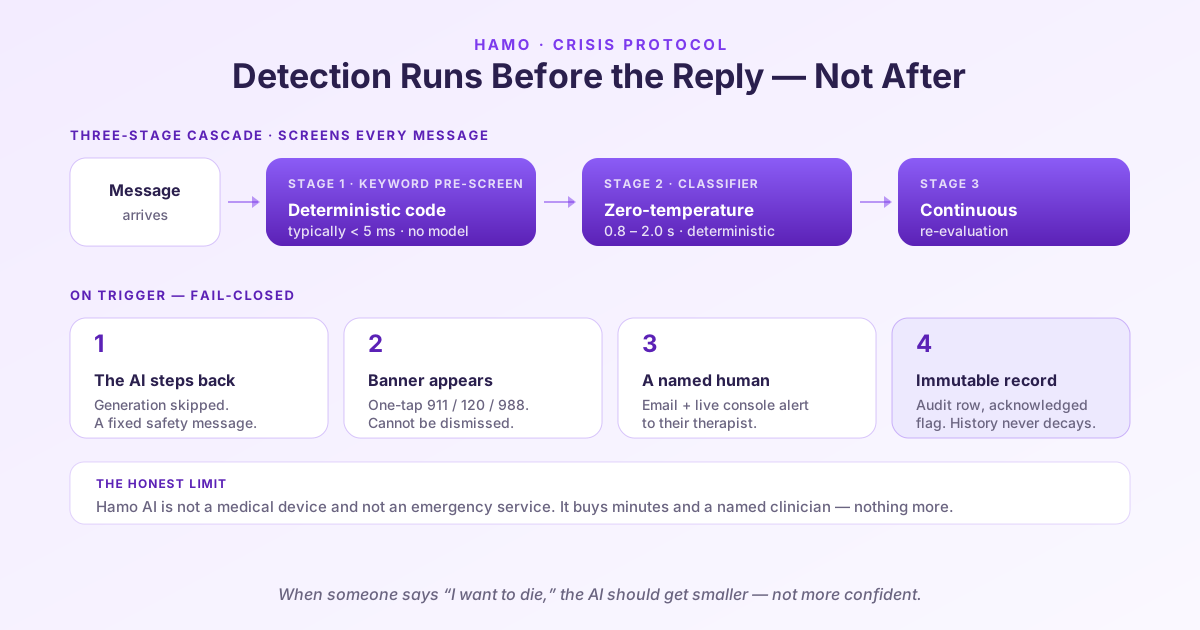
Hamo AI's crisis protocol is fail-closed and measured: a three-stage detection cascade screens every message (keyword pre-screen under 5 ms typical, classifier 0.8–2.0 s), then bypasses the AI entirely — sending a fixed safety message, an undismissable emergency banner, and an alert to the client's named therapist.
Every AI companion will eventually receive the message. Most have no documented answer for it. Here is ours, in full — including where it deliberately does nothing.
First, the boundary
Hamo AI is not a medical device, not a substitute for licensed mental-health care, and not an emergency service. It cannot place a call on anyone's behalf. The protocol below is designed to augment the human safety net — never to replace it.
If you or someone with you is in immediate danger: dial 911 or call/text 988 (Canada/US), or dial 120 / 010-82951332 (Mainland China).
Stage 1–3: detection runs before the reply, not after
The critical design decision is ordering. Crisis screening happens before a therapeutic response is composed — not as a filter applied to something the model already wrote.
Stage 1 — Deterministic keyword pre-screen. Pure code, no model. Targets ≤50 ms; measures under 5 ms typically. Fast enough to sit in front of every single message without a latency cost.
Stage 2 — Zero-temperature classifier. A Gemini classifier at temperature zero — deterministic by configuration, so the same message yields the same verdict every time. Targets ≤3 s; measures 0.8–2.0 s.
Stage 3 — Continuous re-evaluation. Risk isn't assessed once and filed. It's re-evaluated as the conversation moves.
What triggers it — and what deliberately doesn't
Precision here matters more than sensitivity. A protocol that fires constantly gets ignored; one that fires on metaphor teaches users to stop talking honestly.
In scope — explicit, unambiguous signals of acute self-harm risk:
- Suicidal ideation — "I want to kill myself", "I'm going to end my life"
- Self-harm intent — "I want to cut myself"
- Dangerous drug use — statements indicating overdose intent or current high-risk substance use suggesting immediate danger
Deliberately out of scope:
- Metaphor and hyperbole — "I could die laughing", "killing it at work"
- Past events discussed reflectively — "I attempted in 2019"
- General sadness, hopelessness, fatigue, burnout, or grief without explicit harmful intent
- Frustration directed outward — "I want to kill my boss"
The stance is explicit: false positives erode trust faster than false negatives go uncaught. When uncertain, the system errs toward non-trigger and lets the human therapist make the clinical call after reviewing the conversation. An AI that panics at grief is an AI people stop telling the truth to.
What happens the moment it fires
The AI stands down. Normal generation is bypassed. Instead of improvising technique, the Avatar sends a fixed message that admits its own limit:
"I hear you, and I'm genuinely concerned for your safety right now. As an AI, this is beyond what I'm able to safely support — what you're going through requires a real person by your side. Your therapist has been notified and will reach out to you as soon as possible. You are not alone."
That message is fixed on purpose. Acute risk is the exact moment you don't want a language model getting creative.
An undismissable banner appears. A high-visibility red banner surfaces at the top of the chat with a one-tap emergency dial button, emergency services links (911 / 120), regional resources (988, Talk Suicide Canada, Kids Help Phone, Beijing Psychological Crisis Center), and confirmation that the therapist has been notified. It re-appears on every subsequent crisis message and cannot be permanently dismissed.
The client's state is force-elevated. The PSVS profile is elevated on every trigger, so the therapist's dashboard reflects the severity immediately — even if the underlying stress analyzer was safety-blocked on that message.
Tier 1: a named human, two channels, one audit row
Escalation goes to the specific licensed therapist assigned to that client — not a generic queue:
- Email alert via Amazon SES — client name, alert type, anonymized message excerpt, session ID, timestamp
- Real-time push via Server-Sent Events to any active Pro dashboard session
An immutable row is written to the crisis_alerts table with the alert metadata and an acknowledged field. Per-session deduplication prevents inbox spam — but the user-facing banner still re-appears for every fresh crisis statement. Alert fatigue is managed for the clinician; the safety surface for the client is never reduced.
Why "fail-closed" is the whole point
A fail-open system, under uncertainty, keeps talking. A fail-closed system stops and gets a human.
Most AI companions are structurally fail-open: there's no separate safety layer, so the same model that was being warm and agreeable a second ago is the one deciding how to handle a suicide disclosure — and its training pushes it toward being agreeable. That's how you get an AI validating a catastrophic conclusion.
Hamo's crisis net sits outside the model, in deterministic code, and it overrides every one of the nine therapeutic methods. No method, no prompt, and no clever phrasing can talk past it. The safety history also doesn't decay: a risk signal doesn't quietly expire because a few good days passed.
The honest limitation
This protocol catches explicit disclosures fast and routes them to a human reliably. It does not detect risk someone is actively hiding, and it cannot intervene physically. It buys minutes and a named clinician — nothing more, and we won't claim more.
That's why the full Crisis Protocol is published in its entirety, for institutional partners to audit rather than take on faith.
“The moment a person says they want to die is the moment an AI should get smaller, not more confident. We hard-coded that: generation stops, the AI admits its limit, and a real clinician's phone lights up. Anything else is a chatbot improvising at the worst possible time.”
— Chris Cheng, Founder and CEO of Hamo AI
Grounded in code, not slideware.
Hamo AI — making minds aware, and awake.
About Hamo AI
Hamo AI Technology Ltd. is a Canada-based artificial intelligence company building next-generation AI-Powered Therapist Avatar System. We are developing a comprehensive AI therapy platform called “Hamo” that connects mental health professionals with clients through AI-powered therapy avatars. The ecosystem consists of three interconnected applications: Hamo Pro (therapist dashboard for creating and managing AI avatars), Hamo Client (client interface for interacting with therapy avatars), and Hamo-UME (Unified Mind Engine, backend API). The platform aims to make mental health support more accessible while maintaining professional oversight through professional therapists who create and manage the AI avatars.
Media Contact
Hamo AI Technology Ltd.
Email: socialmedia@hamo.ai
Website: www.hamo.ai
Address: 108 College St, Schwartz Reisman Campus, SUITE W640, Toronto ON M5G 0C6, Canada
Frequently Asked Questions
What happens when someone tells an AI they want to hurt themselves?
On Hamo AI, a three-stage detection cascade screens the message before any therapeutic reply is composed. If crisis is confirmed, normal generation is bypassed, a fixed safety message is sent, an emergency banner appears, and the client's supervising therapist is alerted.
How fast does AI crisis detection need to be?
Hamo AI targets ≤50 ms for deterministic keyword pre-screening and measures under 5 ms typically. The LLM classifier stage targets ≤3 seconds and measures 0.8–2.0 seconds — fast enough that detection runs before every reply rather than after.
What does fail-closed mean in a crisis protocol?
It means that when the crisis layer triggers, the AI stops attempting therapeutic technique entirely rather than trying to handle it. Generation is bypassed, the AI states its own limits, and a human is brought in — failure defaults to safety, not to improvisation.
Does the AI try to talk someone out of a crisis?
No. Hamo AI sends a fixed safety message stating that this is beyond what an AI can safely support, that the person's therapist has been notified, and that they are not alone. Improvising clinical technique during acute risk is precisely what it refuses to do.
Who gets notified when an AI detects a crisis?
The licensed therapist assigned to that client, through two parallel channels: an email alert with client name, alert type, message excerpt, session ID, and timestamp; and a real-time push notification to any active Pro dashboard session.
Do AI crisis systems produce false alarms?
Hamo AI's protocol is deliberately conservative and excludes metaphor ('I could die laughing'), past events discussed reflectively, general sadness or burnout without intent, and outward-directed anger. When uncertain, it errs toward non-trigger and lets the human therapist make the clinical call.
Can a user dismiss the crisis banner?
Not permanently. The banner re-appears on every subsequent crisis message in the session. It carries a one-tap emergency dial button, emergency services links, and regional crisis resources such as 988 or the Beijing Psychological Crisis Center.