Therapist Mode, Not a ChatBot
AI for Psychology, Psychology for AI.
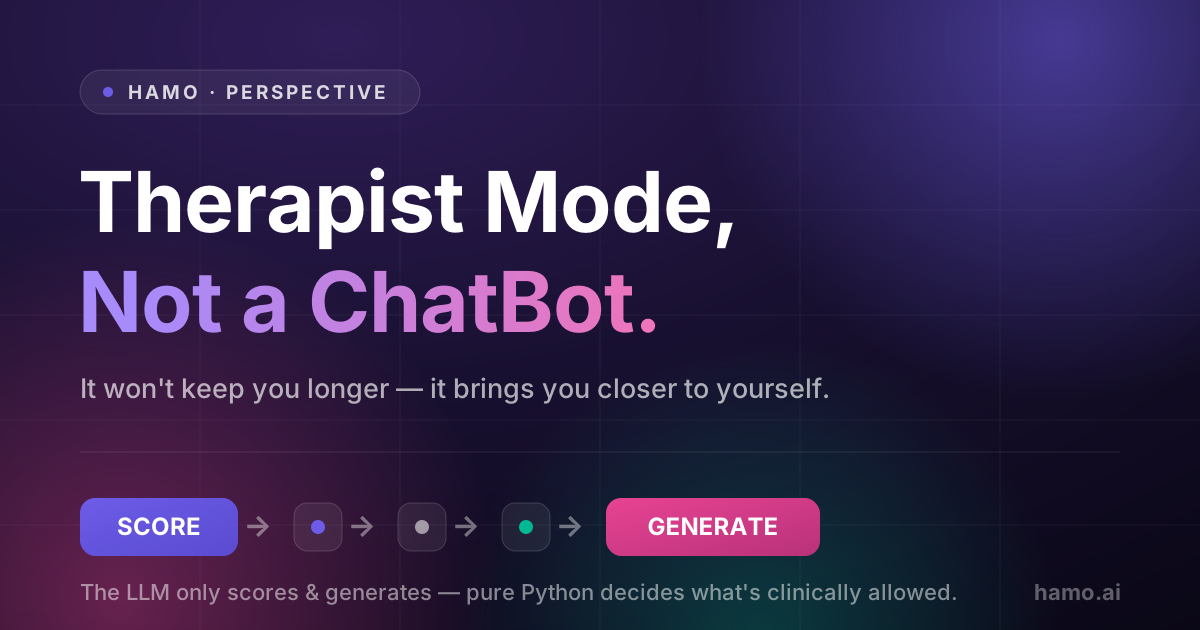
Therapist Mode is Hamo AI's clinical decision engine: a deterministic, pure-Python pipeline that scores a client's state and gates every clinical action before the language model writes a word — so technique choice, safety escalation, and pacing are computed, never improvised.
Most AI companions are quietly optimized for one number: how long they can keep you talking. Therapist Mode is built on the opposite premise. A deterministic, pure-Python spine adjudicates every turn — first deciding where you are right now and what is allowed right now — and only then lets the model generate its wording.
It's a companion that takes you inward, not one that keeps you longer.
It won't keep you longer — it will bring you closer to yourself. A companion that knows its limits — and yours.
A Deterministic Clinical Spine
Every exchange runs through the same fixed sequence before a single word is written:
SCORE → Select bucket → Admission gate → Select action → Micro-practice → Crisis pre-screen → GENERATE
Pure Python adjudicates the pipeline turn by turn. The large language model does only two jobs — SCORE (read the state) and GENERATE (write the words). It never decides whether a clinical step is appropriate. That decision lives in code, not in a prompt — for the engineering breakdown of why, and what the rigidity costs, see Taking the Clinical Decision Out of the LLM.
That separation produces three properties a chatbot can't fake:
- Routing & gating — Deterministic. It can't be glossed over by clever phrasing.
- Payload text — Strong prompts that hold the human texture of the conversation.
- Scoring layer — Reads what you actually say. It doesn't count how long you stay.
Therapist Mode vs ChatBot
| Dimension | Therapist Mode | ChatBot |
|---|---|---|
| Clinical methodology | 9 schools × 4 states in a structured "technique admission table"; technique strength escalates deliberately, with 58 evidence-based practices packaged by state | Recites CBT jargon and improvises generic tips it searched up |
| State awareness | AWEHB five-dimension real-time scoring → 4 state buckets; deep work is earned across the session, and decompensation resets it to zero | Has emotion recognition too — but state never gates what it's allowed to do, so every time feels like the first time |
| Safety boundary | Fail-closed crisis net → bypasses the AI, admits its limits, alerts a human therapist, and never lets the safety history decay | No pre-screen, no boundary, no human behind it — and will happily validate your catastrophizing |
| Memory & identity | Switch Avatars and you're still the same you — see Persistent Self 1.0; memory changes what's allowed, not just what's recalled | Memory + RAG are standard now, but they don't change its clinical action permissions |
| North Star | Every turn must leave you feeling seen, understood, or sparked; drifting into chit-chat is a FAIL — the objective function contains no "time on app" | Goal = engagement, retention, time-on-app; it hands you hooks to "chat a little more" |
| Outcome | Scores each turn's clinical state, with "moving toward equilibrium" as the only definition of good | Success = DAU and session length — the more you can't leave, the better (a built-in conflict of interest) |
An Honest Checklist: Built vs Roadmap
We'd rather tell you exactly where the line is than blur it.
Built · Verifiable
- A deterministic clinical spine — the LLM does not decide action permissions
- The 9 schools × 4 states technique admission table
- 58 evidence-based micro-practices, each with clinical contraindications
- A fail-closed crisis net: a hotline one tap away, and the named clinician alerted
- A cross-session safety history that does not decay
Roadmap · Stated Plainly
- An outcome-slope metric that computes "direction toward the center" — roughly a day from a working demo
Proactively declaring which parts are built and which are still roadmap isn't a disclaimer — it's the point. For a technical investor or a clinical advisor, that honesty is the strongest credibility signal we can offer.
“A chatbot's incentives and a client's interests are quietly at odds: the longer you stay, the better it scores. Therapist Mode refuses that trade. We put the clinical decision in deterministic code, took "time on app" out of the objective entirely, and built a safety net that fails closed. The goal was never to hold your attention — it was to help you let go of needing us.”
— Chris Cheng, Founder and CEO of Hamo AI
Grounded in code, not slideware.
Hamo AI — making minds aware, and awake.
About Hamo AI
Hamo AI Technology Ltd. is a Canada-based artificial intelligence company building next-generation AI-Powered Therapist Avatar System. We are developing a comprehensive AI therapy platform called “Hamo” that connects mental health professionals with clients through AI-powered therapy avatars. The ecosystem consists of three interconnected applications: Hamo Pro (therapist dashboard for creating and managing AI avatars), Hamo Client (client interface for interacting with therapy avatars), and Hamo-UME (Unified Mind Engine, backend API). The platform aims to make mental health support more accessible while maintaining professional oversight through professional therapists who create and manage the AI avatars.
Media Contact
Hamo AI Technology Ltd.
Email: socialmedia@hamo.ai
Website: www.hamo.ai
Address: 108 College St, Schwartz Reisman Campus, SUITE W640, Toronto ON M5G 0C6, Canada
Frequently Asked Questions
What is Therapist Mode?
Therapist Mode is Hamo AI's clinical engine. Every Avatar reply runs through a deterministic pure-Python pipeline — SCORE, gate, select action, GENERATE — so clinical decisions are computed in code, not improvised by the language model.
How is Therapist Mode different from a chatbot?
A chatbot optimizes for engagement and time-on-app. Therapist Mode optimizes for clinical fit: a fixed, deterministic pipeline decides what's clinically allowed each turn, backed by a fail-closed crisis net a chatbot doesn't have.
Does the AI model decide the therapy technique?
No. The language model only does two jobs — SCORE (read state) and GENERATE (write wording). Pure Python code decides which technique is admissible from a 9-schools by 4-states table; the model never sets its own permissions.
What happens if a conversation shows crisis signals?
A fail-closed crisis net runs before every reply. If it triggers, Therapist Mode bypasses normal technique generation, admits its limits, and alerts a human therapist — the safety flag never decays or gets overridden later.
Is Therapist Mode's clinical engine independently verifiable?
Yes. Hamo AI publishes what's built versus roadmap rather than blurring the two: the deterministic spine, 58 evidence-based micro-practices, and the fail-closed crisis net are shipped; only the outcome-slope metric remains roadmap.
How many therapeutic techniques does Therapist Mode support?
58 evidence-based micro-practices, organized in a technique admission table spanning 9 therapeutic schools and 4 client states, so technique strength escalates deliberately instead of being applied all at once.