PHIPA-Compliant AI in Mental Health: Note-Takers vs Client-Facing Avatars
AI for Inner Explorers.
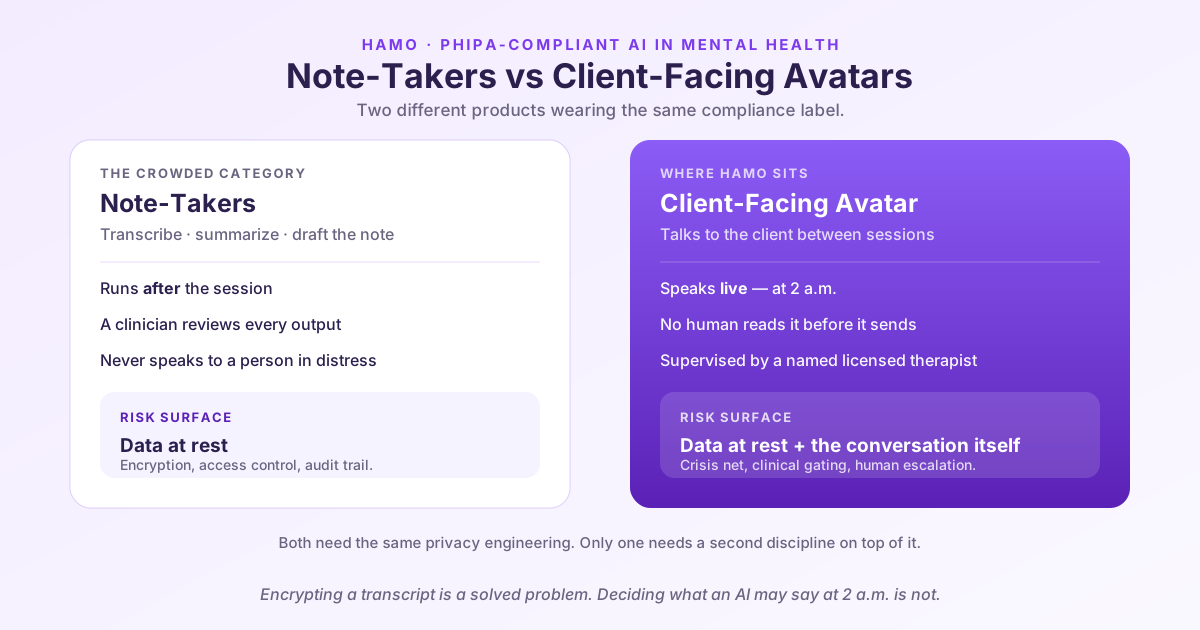
Most "PHIPA-compliant AI" in mental health is documentation software — it transcribes and summarizes sessions for the clinician. Hamo AI occupies a different category: a PHIPA 6.1-audited, client-facing Avatar that talks directly to clients between sessions, under a named licensed therapist's supervision.
The distinction sounds like positioning. It's actually a statement about risk.
Two categories that get filed under one label
Search the market and nearly every PHIPA-compliant AI mental-health tool is some flavor of the same thing: record the session, transcribe it, draft the note, let the clinician approve. Useful work — and a genuinely bounded problem.
A note-taker's risk surface is data at rest. It handles sensitive data, so it needs encryption, access control, and an audit trail. But it processes a recording after the fact, and a clinician reviews the output before it means anything. The AI never says a word to a person in distress.
A client-facing Avatar's risk surface includes the conversation itself. It speaks directly to a client at 2am, with no human reading each message before it sends. Encryption is table stakes. The hard part is everything else: what is safe to say right now, to this person, in this state.
Those two products need the same privacy engineering — and then one of them needs a whole second discipline on top.
What the second discipline requires
Hamo AI's PHIPA 6.1 audit covers the privacy half: TLS 1.2+ in transit, AES-256 at rest under customer-managed keys across all 11 data tables, three-tier role separation, mandatory MFA on every entry point, full PHI audit logging, bcrypt at cost factor 12, and a 30-minute enforced idle timeout.
The client-facing half is where the category diverges:
Crisis detection runs before every reply, not after. A three-stage cascade — deterministic keyword pre-screen, a zero-temperature classifier, and continuous re-evaluation — screens each message. Keyword detection targets ≤50 ms and measures under 5 ms typically; the classifier targets ≤3 s and measures 0.8–2.0 s. A note-taker needs none of this, because nothing it produces reaches a client.
The model doesn't choose its own clinical actions. In Therapist Mode, deterministic Python decides which techniques are admissible from a 9-schools × 4-states table. The language model only scores state and generates wording. A documentation tool has no equivalent problem — it isn't making clinical moves.
A named human is accountable. Every Avatar is built and supervised by a licensed therapist. Crisis events escalate to that specific clinician through two parallel channels — an email alert and a real-time push to their dashboard — with an immutable audit row recording the alert and whether it was acknowledged.
The safety history doesn't decay. A risk signal from three weeks ago still constrains what's permitted today. Documentation tools have no state to carry forward; a companion absolutely does.
Why the category gap exists
It's not an oversight. It's that autonomous client-facing AI is hard to make defensible, so most serious vendors sensibly chose the bounded problem.
Hamo AI's answer isn't to claim the autonomous version is solved. It's to reject the premise: the Avatar isn't autonomous. It runs a therapeutic method a licensed clinician selected, inside permissions that clinician's framework defines, with escalation to that clinician when something exceeds what an AI should hold. The therapist stays in the loop — architecturally, not as a disclaimer.
That's the position we think the category was missing: not "AI instead of a therapist," and not "AI that only types notes for one," but AI that extends a specific therapist's care into the 167 hours a week they aren't in the room.
A precise note on jurisdiction
PHIPA is Ontario's framework. It is the Canadian analog to HIPAA, not the same statute. Hamo AI is audited against PHIPA 6.1; practices operating under US HIPAA jurisdiction should contact us so we can address their specific regulatory position directly rather than imply coverage we haven't claimed.
“Encrypting a transcript is a solved problem. Deciding what an AI is allowed to say to someone at their lowest is not — and that's the part the industry keeps routing around. We'd rather build the harder category honestly than the easy one loudly.”
— Chris Cheng, Founder and CEO of Hamo AI
Grounded in code, not slideware.
Hamo AI — making minds aware, and awake.
About Hamo AI
Hamo AI Technology Ltd. is a Canada-based artificial intelligence company building next-generation AI-Powered Therapist Avatar System. We are developing a comprehensive AI therapy platform called “Hamo” that connects mental health professionals with clients through AI-powered therapy avatars. The ecosystem consists of three interconnected applications: Hamo Pro (therapist dashboard for creating and managing AI avatars), Hamo Client (client interface for interacting with therapy avatars), and Hamo-UME (Unified Mind Engine, backend API). The platform aims to make mental health support more accessible while maintaining professional oversight through professional therapists who create and manage the AI avatars.
Media Contact
Hamo AI Technology Ltd.
Email: socialmedia@hamo.ai
Website: www.hamo.ai
Address: 108 College St, Schwartz Reisman Campus, SUITE W640, Toronto ON M5G 0C6, Canada
Frequently Asked Questions
What does PHIPA-compliant mean for an AI mental health tool?
PHIPA is Ontario's Personal Health Information Protection Act. For an AI tool it means verified technical controls: encryption in transit and at rest, role-based access control, mandatory MFA, audit logging of every PHI access, and enforced session timeouts.
What is the difference between an AI note-taker and a client-facing AI Avatar?
A note-taker processes a recording after a session and only a clinician sees the output. A client-facing Avatar talks directly to a client in real time, which means it can cause harm in the moment — a fundamentally larger risk surface requiring crisis detection and clinical gating.
Why are most PHIPA-compliant AI tools note-takers rather than companions?
Because documentation is a bounded problem: transcribe, summarize, let a clinician approve. A client-facing Avatar must decide what is clinically safe to say in real time, with no human reviewing each message before it sends — which is much harder to make safe.
Is Hamo AI a PHIPA-compliant client-facing AI?
Yes. Hamo AI completed a full technical PHIPA 6.1 audit in April 2026 across all four platform components, and it is client-facing: Avatars talk directly to clients between sessions under the supervision of the licensed therapist who built them.
Who is clinically accountable when an AI Avatar talks to a client?
The licensed therapist who built and supervises the Avatar. Hamo AI's model is explicitly not autonomous care — the therapist selects the therapeutic method, and crisis events escalate to that named therapist through email and real-time dashboard alerts.
What extra safeguards does a client-facing AI need beyond encryption?
Three at minimum: real-time crisis detection that runs before every reply, clinical gating so the model can't choose its own techniques, and a named human clinician who receives escalations — none of which a documentation tool requires.