Hamo AI Releases Persistent Self 1.0 and AI Mind 2.0 — The Next Leap in Psychological Semantic Modeling
AI for Psychology, Psychology for AI.
Persistent Self 1.0 is Hamo AI's seven-level model of long-term psychological memory — Memory, Sketch, Recall, Reflection, Multi-Self, World Model, Self Model — paired with AI Mind 2.0, a 14-category per-Avatar narrative store, so every Avatar remembers who a client is, not just what they said.
Toronto, Canada — May 15, 2026 — Hamo AI Technology Ltd. today announces two foundational upgrades to its therapeutic AI engine: Persistent Self 1.0, a seven-level model of long-term psychological memory, and AI Mind 2.0, a fourteen-category per-Avatar narrative store. Both releases ship with an upgraded Psychological Semantic Vector Space (PSVS) — the substrate that lets Hamo Avatars actually learn who you are, conversation after conversation, Avatar after Avatar.
Most AI systems forget you the moment a session ends. Hamo is built to do the opposite.
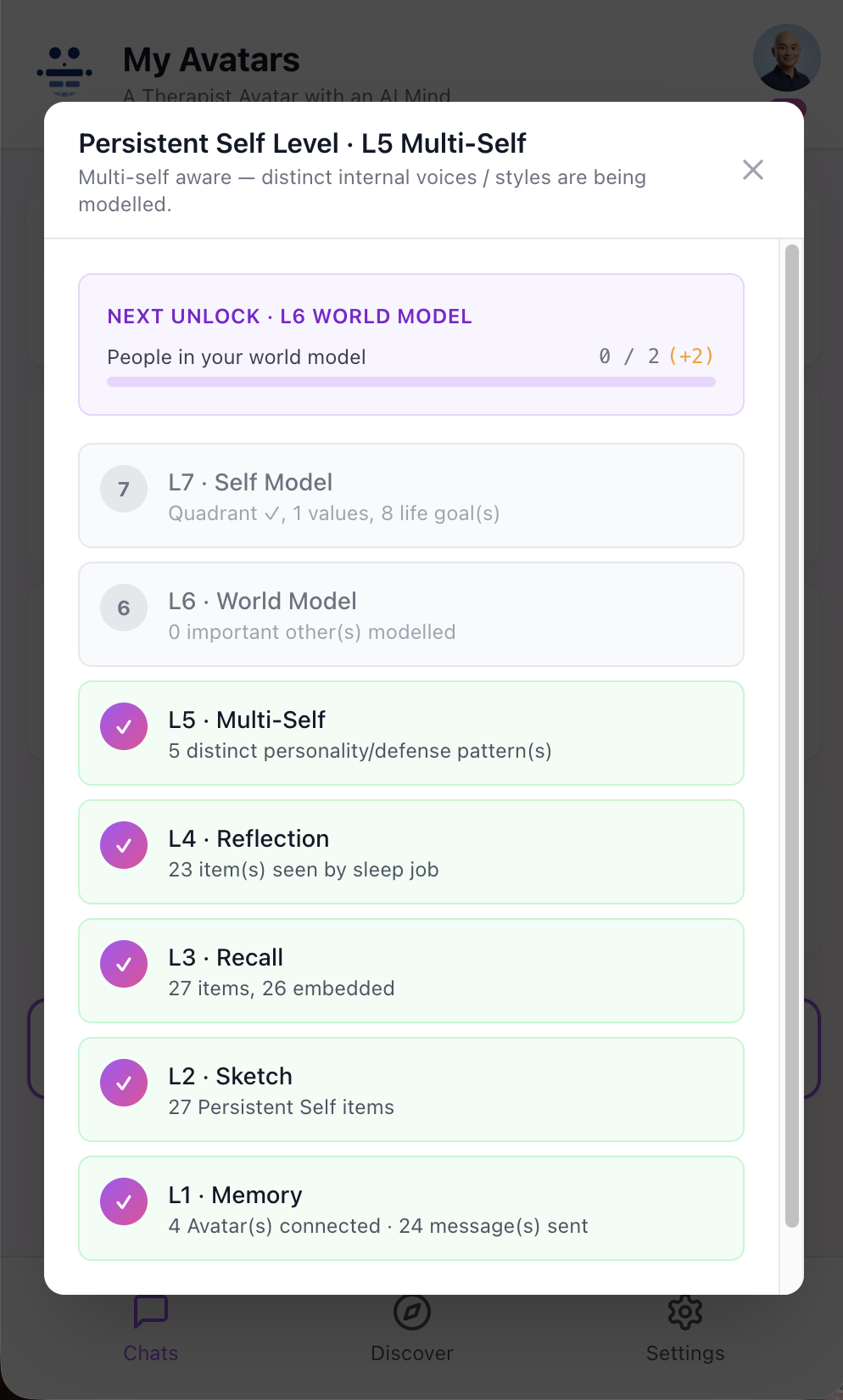
Persistent Self 1.0 — Seven Levels of Psychological Depth
The Persistent Self is the part of Hamo that remembers, integrates, and reflects on who a person is across every Avatar they talk to. It is the long-arc memory of the system — not a transcript, but a structured psychological self-model that grows with the user.
Persistent Self 1.0 introduces seven progressive levels. Each unlocks the next as conversations accumulate; nothing is invented, everything is grounded in what the user has actually said.
L1 · Memory
The raw signal. Avatars connected, messages exchanged, the conversational substrate. Memory is what flows in.
L2 · Sketch
Conversations are distilled into Persistent Self items — structured fragments of identity, experience, and feeling extracted from raw dialogue. A first draft of the self, in writing.
L3 · Recall
Sketches are embedded into the Psychological Semantic Vector Space. Future Avatars can retrieve and reuse them by meaning, not by keyword — so the right context surfaces at the right moment.
L4 · Reflection
A sleep job runs over the accumulated material and synthesizes higher-order observations — patterns, recurrences, the shape of recurring feelings. The system begins to think about what it has seen.
L5 · Multi-Self
Distinct internal voices, defense patterns, and personality styles are modelled as separate selves within the same person. Therapeutic care has always treated the psyche as plural — Persistent Self 1.0 makes that pluralism computable.
L6 · World Model
The important others in a person's life — partner, parent, child, manager, the late friend they still think about — get modelled too. These people shape who the user is; the system needs to know them.
L7 · Self Model
The summit: a quadrant assessment, anchored values, and life goals — a coherent self-model the system can reason with, plan against, and re-evaluate over time.
AI Mind 2.0 — A 14-Category Narrative Store
If Persistent Self is the vertical depth of psychological modelling, AI Mind 2.0 is the horizontal breadth.
AI Mind 2.0 ships as a per-Avatar Comprehensive Narrative Store that organizes everything a single Avatar knows about a single client into 14 structured categories, across three domains.
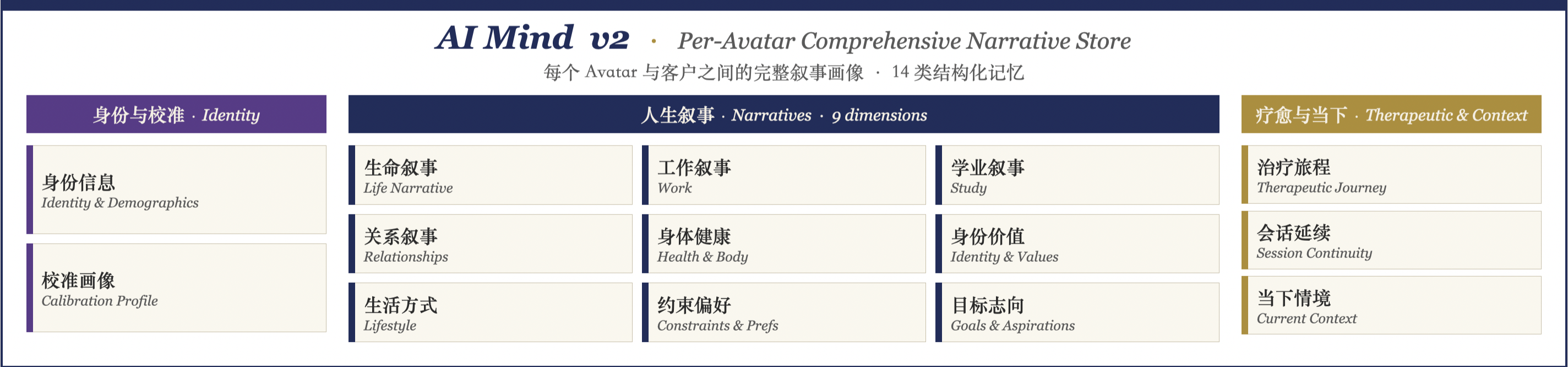
Identity & Calibration — who they are
- Identity & Demographics — the factual self
- Calibration Profile — how this person prefers to be met, paced, and challenged
Life Narratives — what they live (9 dimensions)
- Life Narrative · Work · Study
- Relationships · Health & Body · Identity & Values
- Lifestyle · Constraints & Preferences · Goals & Aspirations
Therapeutic & Context — where they are right now
- Therapeutic Journey — the arc of clinical work over time
- Session Continuity — what was opened last time, still pending
- Current Context — what is true for them today
Together these 14 categories give the Avatar a clinically-shaped picture of the person — not a chat log, but a case formulation the AI can actually reason from. The categories are co-designed with practising therapists and update continuously as conversations happen.
Why This Matters — Know U · Care U · Enable U
Persistent Self and AI Mind are designed to deliver on Hamo AI's three-part value promise:
- Know U — A system that has actually been listening, across every Avatar and every session, with a structured memory of who the user is.
- Care U — Care that takes the user's history, their people, and their inner plurality seriously — because the AI Mind is shaped by clinical insight, not generic intent.
- Enable U — When the model understands the user's Self Model, World Model, and therapeutic journey together, it can do more than answer — it can help them move.
This is what we mean by Psychological Semantic Vector Space: a substrate where meaning is preserved across conversations, where every Avatar inherits a continuous understanding of the person, and where the system grows alongside the user instead of resetting.
“For too long, AI has been built to react to a single message. Persistent Self and AI Mind 2.0 are our commitment to building AI that learns who you are over time — with the rigor a therapeutic system demands and the humility the inner life deserves.”
— Chris Cheng, Founder and CEO of Hamo AI
Hamo AI — making minds aware, and awake.
About Hamo AI
Hamo AI Technology Ltd. is a Canada-based artificial intelligence company building next-generation AI-Powered Therapist Avatar System. We are developing a comprehensive AI therapy platform called “Hamo” that connects mental health professionals with clients through AI-powered therapy avatars. The ecosystem consists of three interconnected applications: Hamo Pro (therapist dashboard for creating and managing AI avatars), Hamo Client (client interface for interacting with therapy avatars), and Hamo-UME (Unified Mind Engine, backend API). The platform aims to make mental health support more accessible while maintaining professional oversight through professional therapists who create and manage the AI avatars.
Media Contact
Hamo AI Technology Ltd.
Email: socialmedia@hamo.ai
Website: www.hamo.ai
Address: 108 College St, Schwartz Reisman Campus, SUITE W640, Toronto ON M5G 0C6, Canada
Frequently Asked Questions
What is Persistent Self 1.0?
Persistent Self 1.0 is Hamo AI's seven-level model of long-term psychological memory — Memory, Sketch, Recall, Reflection, Multi-Self, World Model, and Self Model — building a structured, cross-Avatar understanding of who a client is over time.
What is AI Mind 2.0?
AI Mind 2.0 is a per-Avatar Comprehensive Narrative Store organizing everything an Avatar knows about a client into 14 structured categories across three domains: Identity & Calibration, nine Life Narrative dimensions, and Therapeutic & Context.
Does switching Avatars reset a client's memory?
No. Persistent Self memory is cross-Avatar by design — Levels 1 to 3 (Memory, Sketch, Recall) are embedded into a shared Psychological Semantic Vector Space, so a new Avatar inherits meaningful context instead of starting from zero.
What is the Psychological Semantic Vector Space (PSVS)?
PSVS is the substrate where Hamo embeds distilled conversational fragments so meaning, not just keywords, can be retrieved across sessions and Avatars, letting the right context surface at the right moment in a new conversation.
How many narrative categories does AI Mind 2.0 track?
14 categories across three domains: 2 under Identity & Calibration, 9 Life Narrative dimensions (life narrative itself, work, study, relationships, health and body, identity and values, lifestyle, constraints and preferences, goals and aspirations), and 3 under Therapeutic & Context.
What is the highest level of Persistent Self, and what does it capture?
Level 7, Self Model — a quadrant assessment, anchored values, and life goals forming a coherent self-model the system can reason with, plan against, and re-evaluate as the client's life changes.