The Lamp Can Only Be Lit From Within: 25 Fields Medalists, a Severe Misalignment, and Hamo's Understandability Principle
AI for Inner Explorers.
Reading 25 Fields Medalists' "A Severe Misalignment of AI in Mathematics" against the one principle Hamo holds from "AI for Psychology" to "Psychology for AI".
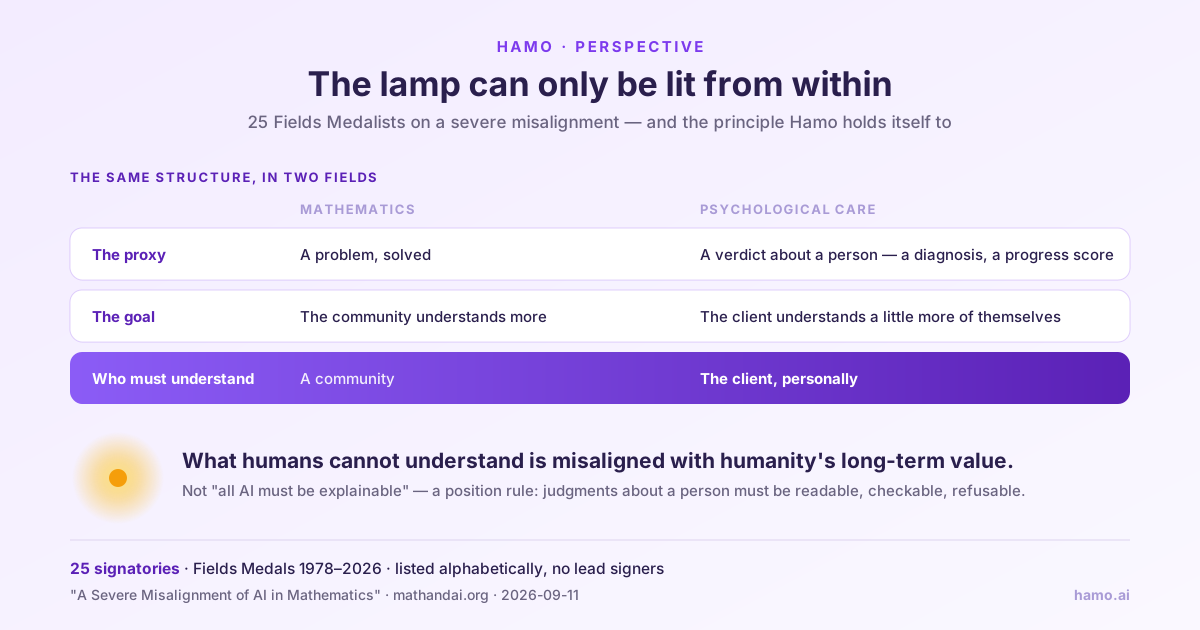
On 11 September 2026, 25 Fields Medalists published a statement: the way AI companies are pushing mathematics forward has become severely misaligned with the goals of the mathematical community. This article does three things. First, it reads the statement accurately — including what it does not say. Second, it lines the statement's core up against Hamo's own principle. Third, it turns that ruler around and measures Hamo with it, because we are an AI company, and so we already sit on the side the statement criticises.
What humans cannot understand is misaligned with humanity's long-term value.
The one principle Hamo holds from "Today" to "Beyond" · this article is the first time it has been written down
The conclusion in one paragraph. The core of the statement is this: solving problems is only a proxy for understanding, and AI companies are optimising the proxy. Hamo faces the same structure in psychology, and in a sharper form — in mathematics the one who needs to understand is a community; in psychology it is the client, personally. So "Today", Hamo has already written three rules into code: no progress verdicts, the lamp can only be lit from within, and Hamo takes no credit. In the "Beyond", the part of this statement we most need to hear is one step on our loop — "Models, distilled → General AI, informed": what we hand over must be structure people can read, not a machine that is better at reaching conclusions about minds and that nobody can read.
Part One · Reading the statement accurately
What it says, and what it doesn't
1. What the statement says
The statement runs nine paragraphs. It was published at mathandai.org and reposted in full the same day through signatories' personal channels. All 25 first signatories are Fields Medalists, listed side by side in alphabetical order by surname — no lead signers, no ranking. According to the signatories, the text came out of discussions among them over the preceding week; because the matter was urgent, there was no time for a round of public consultation of the kind the earlier Leiden Declaration went through. The site is open for anyone to co-sign (confirmed by ORCID or an academic email); as of writing (2026-09-12), roughly 4,930 people had.
Here are all 25 signatories, in the order the statement lists them, with the year each received the Fields Medal — from 1978 to 2026, nearly half a century:
| # | Signatory | Fields Medal |
|---|---|---|
| 1 | Artur Avila | 2014 |
| 2 | Manjul Bhargava | 2014 |
| 3 | Caucher Birkar | 2018 |
| 4 | Pierre Deligne | 1978 |
| 5 | Yu Deng | 2026 |
| 6 | Simon Donaldson | 1986 |
| 7 | Hugo Duminil-Copin | 2022 |
| 8 | Alessio Figalli | 2018 |
| 9 | Martin Hairer | 2014 |
| 10 | June Huh | 2022 |
| 11 | Maxim Kontsevich | 1998 |
| 12 | Elon Lindenstrauss | 2010 |
| 13 | Pierre-Louis Lions | 1994 |
| 14 | James Maynard | 2022 |
| 15 | Curtis McMullen | 1998 |
| 16 | Shigefumi Mori | 1990 |
| 17 | Ngô Bảo Châu | 2010 |
| 18 | Andrei Okounkov | 2006 |
| 19 | Peter Scholze | 2018 |
| 20 | Stanislav Smirnov | 2010 |
| 21 | Terence Tao | 2006 |
| 22 | Maryna Viazovska | 2022 |
| 23 | Cédric Villani | 2010 |
| 24 | Wendelin Werner | 2006 |
| 25 | Efim Zelmanov | 1994 |
What the nine paragraphs say, paraphrased one by one (this is not a translation of the original):
| Paragraph | What it says |
|---|---|
| P1 | The mathematical abilities of large models have leapt forward in recent months and can now solve major problems in many areas; but AI companies are chasing problem-solving as a benchmark, which harms mathematics as a science and harms the mathematical community — the two sides' goals are severely misaligned. This is part of a larger alignment problem that is hitting other sciences, the creative professions, and society as a whole. |
| P2–P3 | Doing mathematics is about understanding the fundamental structures of shape, number and natural phenomena. Famous open problems are lighthouses that measure how far understanding has come; once a problem is solved, the community goes through a long process of talks, discussion and simplification until it becomes textbook material that graduate — even undergraduate — students can learn. |
| P4 | The mathematical community is a microcosm of human society. Its most precious resources are students and ideas, and they must be carefully nurtured — students are given problems so that they grow abilities; ideas are passed on through talks, private discussion and careful writing, and connected to earlier work. All of this takes time, and all of it is built on human interaction. |
| P5 | Solving problems is only a tool and a proxy; the real goal is conceptual understanding and insight. Forget that, and the tool turns against the goal; mass-producing "true / false" statements at ever greater speed may destroy the soil in which new ideas grow. |
| P6 | AI solutions are often announced in a hurry, without time to write them up properly, distil new methods, or cite others' earlier work — which creates serious problems of attribution and plagiarism. And unless there are mathematicians willing to develop AI-conceived ideas and fold them into the mathematical canon, those ideas will never truly come alive, and the crucial human chain of transmission between mathematicians will break. |
| P7 | This is a general threat to all intellectual work: years of training were never only about producing answers, but also about growing understanding and the ability to pose new questions. Once AI can produce results directly, those two purposes are no longer aligned. The question everyone will face is: as AI changes how work is done, do not forget what that work was originally meant to achieve. |
| P8 | AI has the potential to enhance and accelerate genuine mathematical research and understanding, and the profession needs to adapt. But whether the outcome is beneficial or destructive depends largely on the decisions of the people who control the technology. |
| P9 | These problems must be addressed urgently: within the mathematical community, by the companies developing these technologies, and by a society that will soon face the same kind of problem in other intellectual work. |
The sentence that carries the most weight is in P5 — solving problems is "a tool and proxy for achieving the primary goal of conceptual understanding and insight".
— A Severe Misalignment of AI in Mathematics, mathandai.org, 2026-09-11
2. What it doesn't say — reading it right matters more than reading it fast
The statement travelled fast, including across the Chinese-language internet, and a few common extrapolations need to be cleared away first; otherwise everything that follows is built on sand:
- It names no company and makes no specific demands. It is a statement of values, not a list of asks. The words proof, Lean, formal verification and transparency appear nowhere in it.
- It does not say "proofs humans can't understand have no value." What it says is: solving problems is a proxy for understanding; mass-producing true/false judgments may destroy the soil; ideas conceived by AI need people to develop them before they come alive. A signatory has indeed said on social media before that AI solutions of this kind add almost no value — but on the condition that the process is hidden. That is a personal qualification, not the text of the statement.
- It is not against AI. P8 says plainly that AI can enhance mathematical research, and that what decides the outcome is the people who control the technology.
- None of the 25 signatories is a lead signer. Many reports open with one or two famous names "and others, 25 in all" — that is giving examples, and it is not wrong; just know that in the original all 25 stand side by side, which is why this article lists every name. Subheadings in the coverage such as "three core concerns" are editors' summaries, partly drawn from a signatory's personal posts rather than from the statement itself.
The timing has a concrete backdrop. Three days earlier, OpenAI announced a finite-time blow-up result for the Navier–Stokes equations, produced by an internal AI system and accompanied by a Lean formalisation, which immediately set off a dispute over attribution and priority; when the statement was reposted through a signatory's personal channel, it came with The Economist's same-day coverage attached. But the statement's text deliberately frames the issue as a general problem rather than a single case — and that is the premise that lets this article hold it up against Hamo.
3. The core: the proxy ate the purpose
Compress the nine paragraphs into one layer of structure and you get three concerns stacked on a single judgment:
| Concern | What it looks like in mathematics | Where |
|---|---|---|
| ① Answers replace understanding | The leaderboard counts "how many problems were solved", while the purpose of mathematics is "how much more is understood". Optimise the proxy to the limit and the purpose gets squeezed out. | P1 · P5 |
| ② The chain of transmission, and attribution | An idea is only alive once people have digested it, developed it and written it into textbooks; hasty announcements skip citation and writing, attribution becomes doubtful, and the person-to-person chain breaks. | P4 · P6 |
| ③ Not just a mathematics problem | Years of training exist to grow understanding and the ability to ask questions; when AI hands over results directly, output and original purpose come apart. | P7 |
The word the statement itself uses is alignment, and it is worth pausing on. The alignment it means is not a model aligning with human instructions; it is the output of a piece of work aligning with what that work was for. That is exactly the territory Hamo's "Psychology for AI" is heading into.
Part Two · The same structure, in psychology
What is already in code today, and what must be held in the Beyond
4. In psychology, this structure is sharper
Carry the statement's structure across:
| Mathematics | Psychological care | |
|---|---|---|
| The proxy (the answer) | A problem, solved | A judgment about a person — a diagnosis, an interpretation, "what you really want is…", a progress percentage |
| The goal (understanding) | The community understands a little more structure | The client understands a little more of themselves; the therapist understands a little more of the client |
| Who must understand | A community | The client, personally |
The last row is the crucial difference. When AI solves a problem in mathematics, the community can still slowly digest it into a textbook. In psychology, understanding has to happen inside the client. An AI that hands over "a conclusion about your interior" takes away precisely what therapy was meant to grow — P7's "years of training were never only about producing answers" becomes, here, "session after session was never only about receiving an explanation."
And the cost is even more asymmetric. There is a sentence in a comment in Hamo's code, written before the statement, that reads like a paragraph added to it:
A client who is collapsing has less capacity to reject a wrong reading, not more.—
psvs/domain_guard.py, explaining why the "no verdicts about the client's interior" red line must scan every state bucket
A mathematician can reject a wrong proof; a person who is collapsing can hardly reject a wrong reading. So Hamo's principle has to be stated more strongly than the statement's:
What humans cannot understand is misaligned with humanity's long-term value. It does not mean "AI must be one hundred percent explainable". It is a position rule: judgments and decisions about a person must exist in a form people can read, check, and refuse. What people cannot read may serve as an instrument; it may not serve as a judge.
5. Today · AI for Psychology: the principle is already written in code
Every row below is the original meaning of code or of already-published writing, not something written for this article. All of it predates the statement — not a response to it, but the same judgment written down in a different field, at a different time.
| The statement's concern | Hamo's existing rule | Where |
|---|---|---|
| The proxy eats the purpose | Data from a covenant (a goal the client sets for themselves) never feeds engagement optimisation — the comment reads: "A goal-shaped object is the host a retention metric would most like to parasitize — not here." The system produces "no percentages, milestones, or progress verdicts — ever." | psvs/covenant.py |
| Answers replace understanding | "The lamp can only be lit from within." The client's awareness space lives in the client; Hamo can never hold it, only keep its ledger: the only admissible entry on the awareness map is the client naming, in their own words, a pattern of their own. If the Avatar said it first and the client merely agreed or repeated it, that is an echo, not awareness. | psvs/awareness_map.py |
| Answers replace understanding | The "napkin red line": the Avatar may not hand the client a verdict about their own interior — "what you really want is…", "deep down, you are…". Hedged wondering is allowed; a verdict is not. | psvs/domain_guard.py |
| Attribution | Every lamp carries its provenance: which session, which of the client's sentences — and the replay shows the full context, including what the Avatar asked. The comment reads: "Honest both ways: Hamo can't take credit, and false self-authorship can't hide." | psvs/awareness_map.py |
| The human chain of transmission | Only a therapist can create an Avatar; the therapist's supervision instructions explicitly take precedence over algorithmic strategy in the prompt. (The framing "the Avatar is the agent, the therapist is the principal" currently lives in the safety dossier and is not yet in code.) | main.py · prompt_generator.py |
| Judgments must be checkable | The admission table is hand-written data — 9 therapeutic approaches × 4 state buckets = 36 cells — that a clinical advisor can review cell by cell without reading Python; "deterministic trigger → deterministic instruction; the LLM executes, never decides" is written in the source comments. | approach_modules.py · curiosity.py |
| The ruler must be auditable | "Why did W score 2.5?" needs an answer a human supervisor can check — a learned space, an explainable ruler. | Hamo blog · AWEHB |
| Academic attribution | Each of AWEHB's five dimensions cites its own academic source; an earlier version filed self-determination theory under Bandura and credited learned helplessness to Beck — both have been corrected. | Hamo blog · AWEHB |
Read this table next to the statement and Hamo's answers to the same problem, in psychology, share one shape: let the system see, record and support human understanding — but never complete that understanding on the person's behalf. The awareness map keeps the ledger and never lights the lamp; the covenant is held, not scored; the red line allows curiosity, never verdicts.
6. Beyond · Psychology for AI: where we most need to listen
The second stage on our homepage is described in one sentence: "We believe that layer belongs in general AI, and we are building it in the open." It comes with a loop — Care, delivered; Minds, understood; Models, distilled; General AI, informed — which finally closes: AI that genuinely understands minds makes the care itself better.
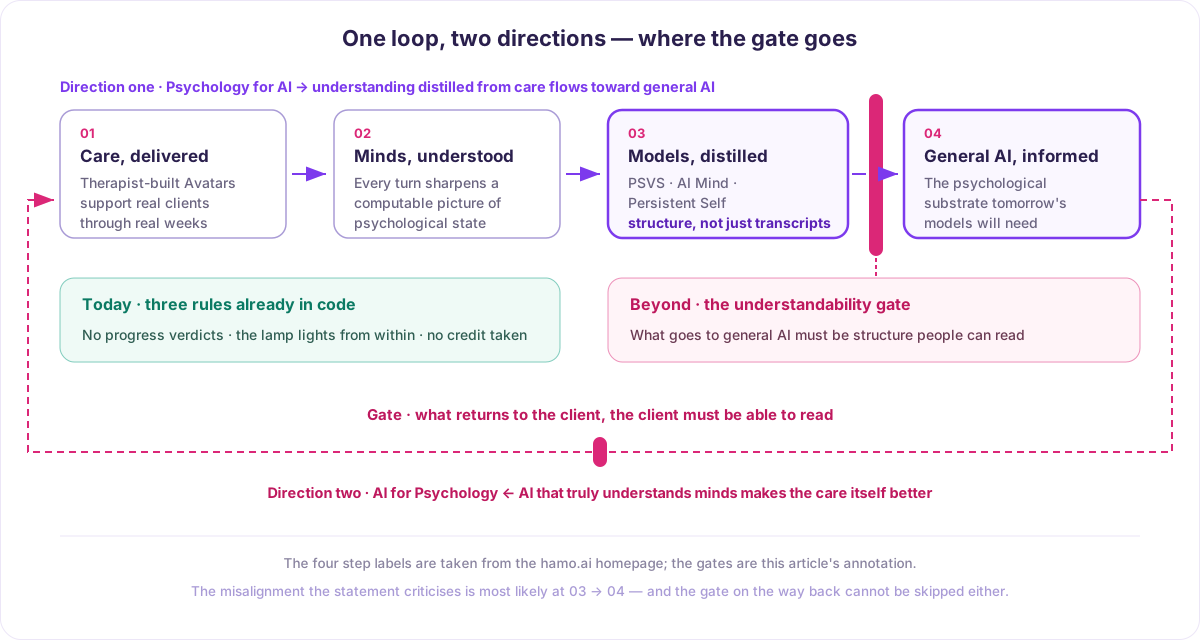
The first two steps of the loop are Today; the last two are Beyond. The kind of misalignment the statement criticises is most likely to happen at "Models, distilled → General AI, informed": if what we hand to general AI is an ability to read minds better than anyone, which nobody can read, then we will have swapped the statement's "mass-producing true/false statements" for "mass-producing conclusions about people" — and the objects are people, not propositions.
So this principle decides what may pass the gate. The homepage wording has in fact already chosen its side: "structure, not just transcripts". What PSVS, AI Mind and Persistent Self hand on should be structure people can open and understand — state, memory, narrative, self; one of the design goals the whitepaper sets for Persistent Self is to "provide a transparent, user-editable visualisation". A structure about you earns the right to flow into general AI only if you yourself can read it and change it.
On "building it in the open", this is how far Hamo has delivered so far:
- Open weights for the scoring model, under the HAMO-RAIL-S licence with four use restrictions: no standalone clinical determinations, no consequential decisions about individuals, consumer-facing deployments must keep an independent crisis path and disclose AI involvement, and no re-identification of individuals;
- An Apache-2.0 toolkit — the crisis gate, a reference server, a synthetic exam, fine-tuning documentation, and a feedback template for "I disagree with this score";
- A model card that discloses, unprompted, the text overlap between the training set and the exam, and the roughly 0.3 percentage points of optimism it introduces;
- Our public line on open source is: we open-source the harness, not the horse — the model comes as a bonus. What is public of the harness today is the toolkit above: the crisis gate, the smoothing reference, the reference server and the self-check exam; the spine runtime, the admission-table schema, the full evaluation suite and the red-team set are not yet public.
"A component that reads someone's psychological state should not be a black box owned by anyone — including us."
— Hamo blog, "Open-Sourcing hamo-score-0.6b"
A discipline of tone. When the homepage was redesigned we set a rule: copy about the Beyond only says "we believe" and "we are building", and makes no present-tense claims about general AI. That is the other side of the "hasty announcements" P6 criticises — the Beyond has not arrived, so don't pop the champagne on its behalf.
Part Three · Turning the ruler on ourselves
We sit on the other side of the table
7. We are an AI company — what the statement criticises could be us
The statement's criticism is aimed at AI companies, and Hamo is an AI company. Ask its question straight back at ourselves: what is our "number of problems solved"?
- The scorer's agreement rates — 85.1% at dimension level, 97.1% at decision level (v7, graded on the 453-turn final exam);
- Downloads on Hugging Face;
- Token consumption, session length, return rate.
All of these are proxies. What we are already aware of: the AWEHB article states that every agreement rate is reliability evidence, not validity evidence — a ruler that gives the same reading every time is not thereby proven to measure length; and AWEHB, as a formative index, has not yet been validated against any external criterion. The covenant and the awareness map both hard-code that they never feed engagement optimisation.
The "hasty announcement" P6 criticises happened to us this month too. In Hamo's internal AWEHB research article, a correction itself later turned out to be wrong — it had ruled two figures that in fact came from the same exam "unrelated"; only after reproducing the number did we find that what was actually wrong was just the value and the level — so it had to be corrected again. That episode stays in the article rather than being erased, because it shows exactly this: the speed of announcing must be slower than the speed of checking.
| The Fields Medalists' statement | Hamo's principle | |
|---|---|---|
| Standpoint | The side being optimised: the mathematical community | The side building the AI — it must apply to itself first |
| Who must understand | A community | The client personally, then the therapist |
| Strength of the claim | Solving problems is a proxy for understanding; don't let the proxy eat the purpose | Stronger: what people cannot understand is misaligned with long-term value |
| Form | A statement of values, with no specific demands | Must become code, gates and checks — otherwise it is only a slogan |
The stronger the claim, the more it has to account honestly for where it still falls short. The next section is that account.
8. Honest boundaries: where Hamo still can't be read
Each item below has been checked against the code. These are the places where the principle has not yet been delivered inside Hamo:
| What can't be read | Current state | What it means |
|---|---|---|
| Rules readable, inputs not | The admission table is hand-written data, but which cell applies depends on the state bucket; the bucket comes from a pressure value, and the pressure value comes from AWEHB scores produced by an LLM or the 0.6B model | Readable rules sit downstream of unreadable readings |
| Memory readable, retrieval not | The memories themselves are structured text; but retrieval ranking runs on cosine similarity over 3072-dimensional vectors. The portal's 3D view is a PCA projection with the original text next to every point | Why this memory was recalled and not that one, nobody can say |
| Open ≠ understandable | The 0.6B scorer has "internalised" the scoring rubric into its weights; the weights are open, but nobody can read from them what it is thinking | Transparency and human readability are two different things |
| The most critical step is a soft constraint | Replies are generated by Gemini; the admission table's "forbidden actions" are only text written into the prompt, with no compliance check after generation | "What must not be said" relies on prompting, not interception |
| Visible, but not yet stopped | The "no verdicts about the client's interior" red line now scans every state bucket, but in the default observe mode it only flags, it does not rewrite | We know how often it happens, but we don't yet prevent it |
| The people who can read it are not the people who most need to | The most complete readable view (the full prompt) is open only to portal administrators; the Pro-side module interface does not expose the 36 cells; psychodynamic-guard hits only go to logs | Therapists and clients see less than operations does |
| Instrument reliable, validity unproven | AWEHB's coefficients come from internal tuning; no published literature gives these numbers, and there is no external criterion validation | It is stable, but not yet proven to measure the right thing |
So for now this principle is a "position principle", not yet a "purity manifesto". Things people cannot read may exist, but only inside instruments — with named outputs, clear boundaries and auditability; judgments about a person, and that person's understanding of themselves, must stay on the side people can read. The two rows that most need fixing first are "Visible, but not yet stopped" and "The people who can read it are not the people who most need to" — the first decides whether a client can be overwhelmed by a wrong reading; the second decides whether the therapist, as principal, can genuinely exercise oversight.
9. Before entering the Beyond: five understandability checks
The statement makes no specific demands because it addresses a whole profession. Hamo addresses its own system, so it can — and should — turn the principle into checks that can be ticked off one by one. Before any component crosses from "Today" toward the "Beyond", it must pass these five questions:
- It can say why. Could a supervisor check where this score, this judgment, came from?
- The person can read it and change it. Can the person being modelled understand, and edit, this structure about themselves?
- Provenance is traceable. Who had this insight first — the client, the therapist, or the model? Would the system take credit on the model's behalf?
- A proxy is labelled as a proxy. Is this number reliability or validity? Is it being optimised as if it were the goal?
- It hands over structure, not conclusions. What it passes to general AI, or puts in front of a client — is it a structure that can be inspected, or a verdict about a person?
These five questions apply to every arrow on the loop, and they apply first to "Models, distilled → General AI, informed". A component that cannot pass questions 2 and 5 should not pass the gate, however capable it is.
10. Closing
The question the statement leaves in P7 is: as AI changes how work is done, do not forget what that work was originally meant to achieve.
What mathematics was meant to achieve is understanding. What psychological care was meant to achieve is a person's understanding of themselves. What Psychology for AI is meant to achieve is an AI that understands minds — and lets people check how it understands. The three are the same thing.
The comment on the awareness map holds everything Hamo understands about its own role: the client's awareness space lives in the client; Hamo can never hold it; Hamo just records the moment each lamp lit.
The lamp can only be lit from within. What Hamo can do is record the moment it lights — and never put the credit in its own name.
External sources: A Severe Misalignment of AI in Mathematics (mathandai.org, 2026-09-11); same-day repost on a signatory's personal blog; QbitAI coverage (2026-09-12). Apart from one quoted sentence, all content from the statement is paraphrased; this article does not represent the views of the signatories.
Hamo sources: psvs/covenant.py · psvs/awareness_map.py · psvs/domain_guard.py · psvs/approach_modules.py · the hamo.ai homepage · Hamo blog, "Measuring the Move" · an internal engineering document on the harness. Code assertions went through one adversarial review, as of 2026-09-12.
Grounded in code, not slideware.
Hamo AI — making minds aware, and awake.
About Hamo AI
Hamo AI Technology Ltd. is a Canada-based artificial intelligence company building next-generation AI-Powered Therapist Avatar System. We are developing a comprehensive AI therapy platform called “Hamo” that connects mental health professionals with clients through AI-powered therapy avatars. The ecosystem consists of three interconnected applications: Hamo Pro (therapist dashboard for creating and managing AI avatars), Hamo Client (client interface for interacting with therapy avatars), and Hamo-UME (Unified Mind Engine, backend API). The platform aims to make mental health support more accessible while maintaining professional oversight through professional therapists who create and manage the AI avatars.
Media Contact
Hamo AI Technology Ltd.
Email: socialmedia@hamo.ai
Website: www.hamo.ai
Address: 108 College St, Schwartz Reisman Campus, SUITE W640, Toronto ON M5G 0C6, Canada
Frequently Asked Questions
What is "A Severe Misalignment of AI in Mathematics"?
A nine-paragraph statement published on 11 September 2026 at mathandai.org, signed first by 25 Fields Medalists. It argues that AI companies are treating the solving of mathematical problems as benchmarks to beat, while for mathematicians solving problems is only a tool and proxy for the primary goal of conceptual understanding and insight — and that this divergence is a severe misalignment, part of a larger alignment problem that will reach every kind of intellectual work. The site is open for anyone to co-sign (confirmed by ORCID or an academic email); roughly 4,930 people had done so as of 12 September 2026.
Who signed the statement?
25 Fields Medalists, listed alphabetically by surname with no lead signers: Artur Avila, Manjul Bhargava, Caucher Birkar, Pierre Deligne, Yu Deng, Simon Donaldson, Hugo Duminil-Copin, Alessio Figalli, Martin Hairer, June Huh, Maxim Kontsevich, Elon Lindenstrauss, Pierre-Louis Lions, James Maynard, Curtis McMullen, Shigefumi Mori, Ngô Bảo Châu, Andrei Okounkov, Peter Scholze, Stanislav Smirnov, Terence Tao, Maryna Viazovska, Cédric Villani, Wendelin Werner and Efim Zelmanov. Their Fields Medals span 1978 to 2026.
Is the statement against AI?
No. Its eighth paragraph says outright that AI has the potential to enhance and accelerate genuine mathematical research and understanding, and that whether the outcome is beneficial or destructive depends largely on the people who control the technology. It names no company and makes no specific demands; the words proof, Lean, formal verification and transparency do not appear in it. It is a statement of values, not a list of asks.
What does "misalignment" mean in the statement?
Not the usual AI-safety sense of a model failing to follow human instructions. The statement means that the output of a piece of work has come apart from the purpose that work was meant to serve: problems get solved faster while understanding — the thing the problems were for — gets crowded out. Its seventh paragraph generalises this: years of training were never only about producing answers, but about growing understanding and the ability to ask new questions.
What does a statement about mathematics have to do with psychological care?
The structure carries over, and it is sharper. In mathematics the proxy is a solved problem and the one who must understand is a community. In psychological care the proxy is a verdict about a person — a diagnosis, an interpretation, a progress percentage — and the one who must understand is the client personally. Handing a client a conclusion about their own interior takes away exactly what therapy is meant to grow. The cost is also more asymmetric: a mathematician can reject a wrong proof, but, as a comment in Hamo's code puts it, a client who is collapsing has less capacity to reject a wrong reading, not more.
What is Hamo's understandability principle?
"What humans cannot understand is misaligned with humanity's long-term value." It does not mean every AI must be one hundred percent explainable. It is a position rule: judgments and decisions about a person must exist in a form people can read, check and refuse. What people cannot read may serve as an instrument, never as a judge. Today it already shows up as three rules in code — no progress verdicts, the lamp can only be lit from within, and Hamo takes no credit — and in the long run it decides what may pass the gate from distilled models into general AI: structure people can read, not a mind-reading machine nobody can.
Does Hamo already live up to this principle?
Not fully, and the article lists where it does not, each point checked against the code: readable admission rules sit downstream of unreadable model scores; memory retrieval ranks by 3072-dimensional vector similarity; open weights are not the same as understandable weights; forbidden actions are prompt text with no post-generation compliance check; the no-verdicts-about-your-interior red line is flagged but not yet rewritten in its default observe mode; the most complete readable view is available to administrators rather than therapists and clients; and AWEHB's coefficients have not been validated against an external criterion. It closes with five understandability checks any component must pass before it moves from today toward general AI.
Does this article speak for the signatories?
No. Apart from one quoted sentence, everything this article says about the statement is paraphrase, and the reading, the comparison with psychological care and every claim about Hamo are Hamo's own.