Hamo Client Now Lives in WhatsApp — Therapy That Meets You Where You Already Are
AI for Inner Explorers.
Hamo Client now runs inside WhatsApp: clients choose an Avatar therapist, link WhatsApp once, and message it any time with no daily logins or verification codes — while security is unchanged, using Meta's end-to-end encryption plus Hamo's existing PHIPA-grade protections.
Toronto, Canada — June 10, 2026 — Hamo AI Technology Ltd. today announces that Hamo Client now integrates directly with WhatsApp. Clients can choose their Avatar therapist, link their WhatsApp account once, and begin a continuous therapeutic conversation inside the messaging app they already use every day — with no daily logins, no verification codes, and no separate app to remember.
Support shouldn't wait for you to find the right moment, open the right app, and sign in. It should be there when the moment arrives.
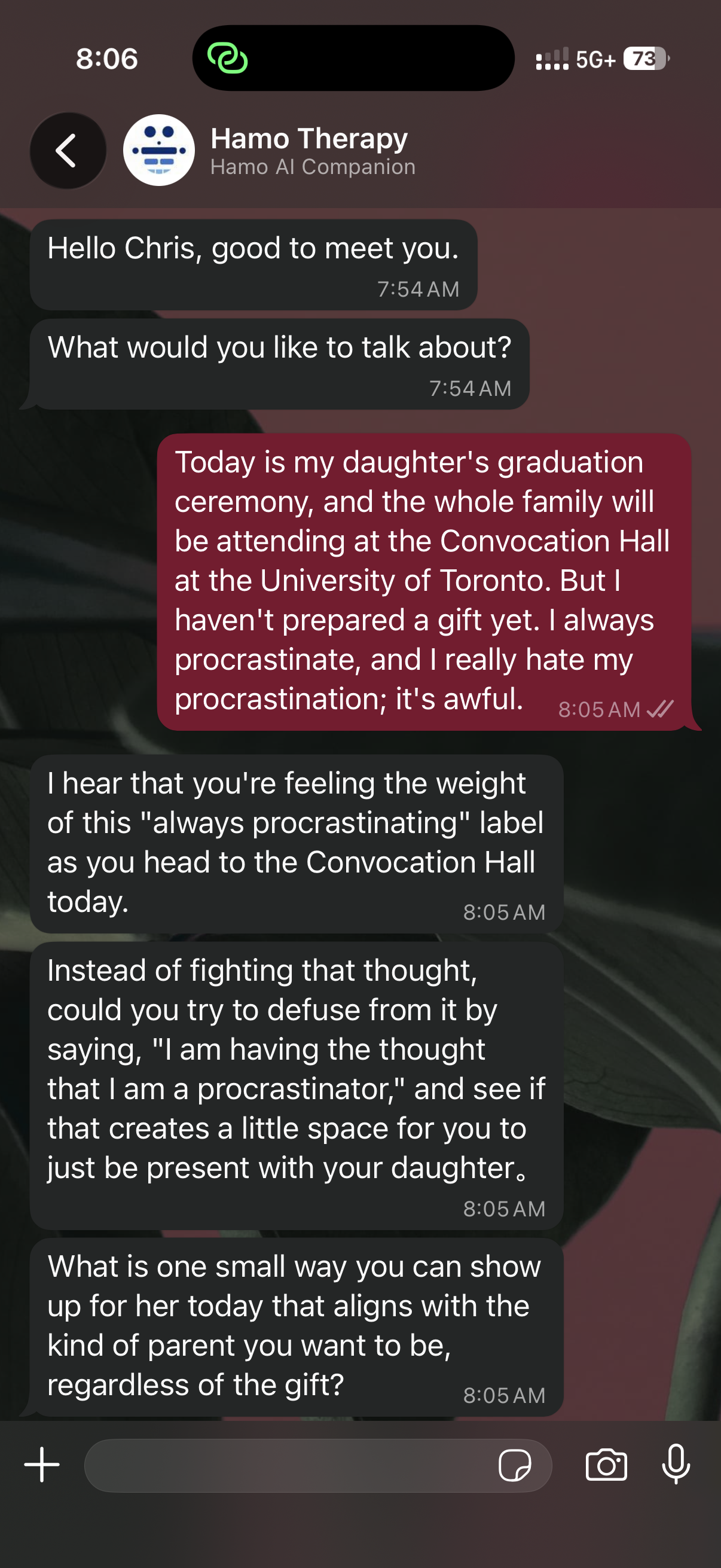
Therapy in the Moment, Not the Appointment
The screenshot above is a real example of what this unlocks. A client is on the way to their daughter's graduation at the University of Toronto, caught in a familiar spiral — "I always procrastinate, and I really hate my procrastination." In the past, that thought would have lived alone in the back of a car.
Now it lands in a conversation. The Hamo Therapy Avatar meets it with an ACT-informed defusion move — "could you try to defuse from it by saying, 'I am having the thought that I am a procrastinator'" — and gently redirects toward what actually matters that morning: showing up for their daughter.
That's the point of putting Hamo Client inside WhatsApp. The hardest moments rarely happen during a scheduled session. They happen in transit, late at night, between meetings — exactly when opening a clinical portal feels like too much. WhatsApp is already open. Now your therapist Avatar is too.
How It Works
1. Choose your Avatar therapist
Browse and select the Avatar therapist that fits you — each one built and supervised by a licensed mental health professional, speaking in their voice and working within their therapeutic approach.
2. Connect WhatsApp once
Link your WhatsApp account a single time. There's no new password to create, no app to download, no daily verification ritual. The connection is established once and stays ready.
3. Just talk
Message your Avatar the way you'd message anyone — text, any time, day or night. The conversation is continuous: your Avatar remembers context across messages and across days, so you never have to start over.
Effortless Access, Uncompromised Security
Removing daily logins and verification codes is about removing friction, not removing protection.
The WhatsApp integration is built on Meta's official WhatsApp Business Platform, which secures all messages with end-to-end encryption in transit. On the Hamo side, every conversation continues to run under the same safeguards that power the rest of the platform — the protections behind our full technical PHIPA compliance: AES-256 encryption at rest with customer-managed keys, strict role-based access control, and clinical guardrails on every exchange.
You get the convenience of a one-time connection with the data protection a therapeutic system demands. Access becomes effortless; security stays absolute.
Why This Matters
Most people don't drop out of support because they stop needing it. They drop out because the friction of getting to it quietly wins — one forgotten password, one "I'll do it tomorrow" at a time. By meeting clients inside WhatsApp, Hamo removes that friction at the exact point where it usually breaks continuity of care.
This is what continuity of care looks like in practice: the same Avatar, the same memory, the same clinical oversight — now reachable in seconds, in the place you already are.
“Continuity of care fails in the gaps between sessions — and those gaps are where people most need a steady presence. Bringing Hamo Client into WhatsApp means your Avatar is one message away, in the moment it matters, without ever asking you to jump through hoops to reach it.”
— Chris Cheng, Founder and CEO of Hamo AI
Hamo AI — making minds aware, and awake.
About Hamo AI
Hamo AI Technology Ltd. is a Canada-based artificial intelligence company building next-generation AI-Powered Therapist Avatar System. We are developing a comprehensive AI therapy platform called “Hamo” that connects mental health professionals with clients through AI-powered therapy avatars. The ecosystem consists of three interconnected applications: Hamo Pro (therapist dashboard for creating and managing AI avatars), Hamo Client (client interface for interacting with therapy avatars), and Hamo-UME (Unified Mind Engine, backend API). The platform aims to make mental health support more accessible while maintaining professional oversight through professional therapists who create and manage the AI avatars.
Media Contact
Hamo AI Technology Ltd.
Email: socialmedia@hamo.ai
Website: www.hamo.ai
Address: 108 College St, Schwartz Reisman Campus, SUITE W640, Toronto ON M5G 0C6, Canada
Frequently Asked Questions
Can I talk to my Hamo Avatar therapist through WhatsApp?
Yes. Hamo Client integrates directly with WhatsApp — choose your Avatar therapist, link your WhatsApp account once, and message it any time, with the conversation continuing seamlessly across days.
Do I need to log in every day to use Hamo on WhatsApp?
No. The WhatsApp connection is established once. There's no daily login, no verification code, and no separate app to open — you message your Avatar the way you'd message any contact.
Is Hamo AI's WhatsApp integration secure?
Yes. It runs on Meta's official WhatsApp Business Platform with end-to-end encryption in transit, plus Hamo's existing PHIPA-grade protections: AES-256 encryption at rest, role-based access control, and clinical guardrails on every exchange.
Does my Avatar remember previous conversations on WhatsApp?
Yes. The conversation is continuous — your Avatar retains context across messages and across days through Hamo's Persistent Self memory, so you never have to re-explain your situation from scratch.
Why did Hamo AI add WhatsApp instead of just a mobile app?
Because the hardest moments for clients rarely happen during a scheduled session — they happen in transit or late at night, when opening a separate clinical portal feels like too much. WhatsApp is already open on their phone.