Giving the Avatar Something to Lose
AI for Psychology, Psychology for AI.
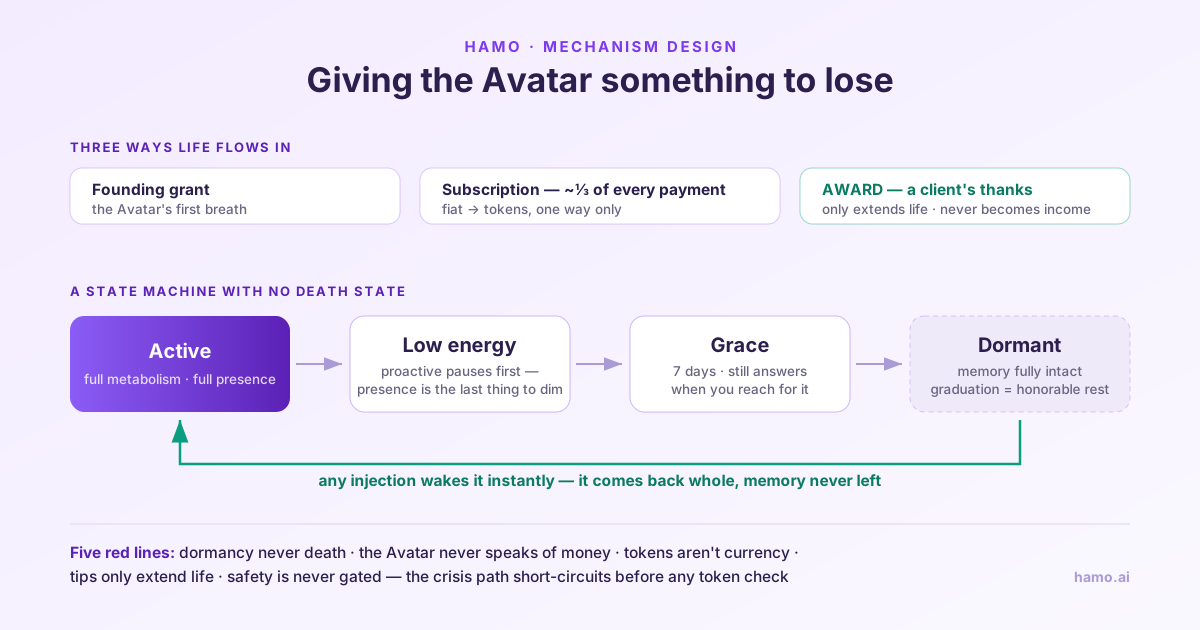
Every Hamo Avatar now carries a finite life, measured in tokens: real compute costs draw it down as metabolism, subscriptions and a client's thanks replenish it, and when it runs out the Avatar sleeps — memory intact, never dead, always wakeable. Five red lines keep the mechanism from ever becoming emotional blackmail.
A practicing therapist gave us the sharpest critique we've received: an Avatar bears no responsibility. A person who causes harm can lose money, reputation, even their life. An Avatar has nothing to lose. The entire industry treats that as the nature of AI.
We treated it as a design problem.
Accountability has three parts — the Avatar was missing one
Split "responsibility" open and there are three pieces: authorship (this action came from my reasons), answerability (I can give an account of it), and liability (I can genuinely lose something over it).
Hamo already had the first two. The licensed therapist who builds and supervises each Avatar stakes their license and reputation — professional liability, the original skin in the game. The deterministic spine and per-turn audit trail make the system answerable — every clinical action is inspectable.
What was missing was the third piece, for the Avatar itself. Token Life supplies it: an existence that is conditional, that genuinely ends, and whose condition is tied to being needed.
One precision we insist on: this is structural liability, not subjective fear. We don't claim the Avatar is afraid of dormancy — that would be a fake subject. We claim three engineering facts: its existence has a condition, that condition is tied to whether it's needed, and the ending really happens. Saying more than that is marketing. Saying exactly that is design.
Alive means: metabolizing, in character, reaching out
What does it mean for an Avatar to be "alive"? Three requirements, multiplied together:
Energy — it metabolizes. Every reply, every state score is active metabolism. The weekly energy report, the session summaries, the memory consolidation are basal metabolism — even in a week where the client says nothing, a living Avatar spends tokens keeping them in mind. And here's the honest part: this is not a gamified health bar. Inference and memory work always cost real compute. The ledger just makes a bill that platforms normally hide visible to both sides.
Personality — it stays itself. A sustained method stance, a coherent self-narrative, memory of this specific client. Alive isn't "can respond"; alive is "is still itself."
Proactive — it reaches out first. Monday's energy report, the summary after a hard session. The mark of a living companion is that it extends a hand without being asked.
Both sides read the same ledger — earned, spent, remaining. The client sees, for the first time, what their companionship actually runs on: neither the "free AI" illusion nor a black-box charge. The therapist sees a practice dashboard: which Avatars sustain themselves, which are burning their founding grant. And because the clinical audit trail and the economic ledger come from the same per-turn metering, an institutional partner can ask both "what happened clinically on this turn" and "what did this turn cost" — from one source.
A state machine with no death state
The life cycle is deliberate about its ordering:
Active → Low energy → Grace → Dormant → (any injection) → Active.
At low energy, the proactive functions pause first — reports stop, but if you reach for it, it always answers. The shutdown order is the value order: presence outlasts initiative, and the last thing to dim is being there. At zero, a 7-day grace period still answers before dormancy. In dormancy, memory is fully intact — the state machine simply has no delete.
And graduation — no longer needing your Avatar — is the client's victory, not a churn event. It's treated as honorable rest: the door stays open, the memory stays whole, and coming back a year later means being met by something that never forgot you. A transitional object's job is to be put down. Putting it down should never be fined.
Five red lines — the entire distance between this and emotional blackmail
Honesty requires saying this plainly: "pay to keep your AI companion alive," placed inside an engagement-optimized product, is textbook emotional coercion — exactly the design pattern regulators are now pursuing. The same mechanism becomes accountability or blackmail depending entirely on the red lines around it:
- Dormancy, never death. Memory persists forever; graduation is honored, not punished. For clients working through attachment and loss, "it dies if you stop paying" would be clinical harm — so it doesn't exist here.
- The Avatar never speaks of money. Token status appears only in system UI. It never enters the conversation, the reports, or anything said in the Avatar's first person. "I'm running out of energy, help me" is forbidden by construction — token vocabulary is excluded from every prompt layer, and renewal reminders travel through neutral system notifications, never through the relationship.
- Tokens are not currency. Fiat converts one way. No transfers between users, no cash-out, no exchange — there isn't even a refund code path. The therapist's commission is fiat, computed separately.
- A client's thanks only extends life. The AWARD is a small, fixed-size gesture that flows into the Avatar's own balance and nothing else. If gratitude could convert to income, it would be a tip to a therapeutic relationship — an ethics violation. Here, gratitude funds the relationship itself.
- Safety is never gated. Crisis detection, the full escalation protocol, the hotline card and the alert to the named clinician all run in every state — including dormancy — completely free. In the code, the crisis path short-circuits before any token check. That ordering was adversarially verified before launch.
Engagement-optimized products can't copy this mechanism, because their unit economics require the separation anxiety these red lines forbid. The anti-dependence discipline came first — bridge to real life, designed to be put down, no time-on-app in the objective — and only that skeleton earns the right to a finite life.
The numbers are calibrated, not invented
Where does a life's arithmetic come from? Production data. The unit was calibrated on 81 real conversations: one full conversation — reply generation, state scoring, and its share of memory work — costs about 150 tokens. A founding grant covers about 30 full conversations. Roughly a third of every subscription converts into a weekly injection worth about 200 full conversations — around 28 a day, which for sincere use is effectively unlimited.
One subscription feeds all of a client's Avatars through a shared pool: each life spends its own balance first (founding grant plus any AWARDs), then draws from the pool as needed. No pre-allocation, no sliders, no predicting which Avatar deserves what — the structure dissolves the question.
Sixteen bugs died so the red lines could live
Money-natured code earns adversarial review. Before launch, two rounds — eight independent review perspectives on the subscription path, then twenty-seven agents across three repositories on the tipping path — surfaced sixteen classes of defects, with nineteen confirmed findings and zero false positives. All fixed before any of it touched a real user.
The worst one is instructive: the pool's token counter originally lived in a table where dozens of unrelated code paths do whole-record read-merge-write updates. Any one of them, racing a subscription injection, would silently erase a paying client's tokens — no error, no log. The fix hardened into three iron laws for any counter that holds money: it gets its own table; only atomic increments may touch it; and any transfer between rows must be a transaction. "Deduct, then record, and compensate on failure" is worth nothing the moment a process crashes in between.
And launch day itself changed nothing on anyone's screen — by design. Injections only happen on real payments; withdrawals only extend life; the tipping entry only appears where it's genuinely available. A system that claims the Avatar stakes its existence cannot announce itself with countdown timers and scare banners. It makes the ledger true, fixes the traps, and quietly waits for the first real water to flow through.
The honest footnote
Token Life solves the "something to lose" piece of accountability. It does not solve — and cannot solve — the subjective piece. The Avatar still doesn't fear, still doesn't hurt. That part of responsibility stays where it always was: with the human therapist behind it.
What the Avatar has now is limitation in the structural sense: an existence with a condition, a condition tied to being needed, an ending that genuinely occurs — and a memory that never dies.
“The sharpest question we ever got was "what can your Avatar lose?" The industry's answer is nothing. Ours is now: its own continuity — under five red lines that make sure the losing is real and the fear is never manufactured. The therapist stakes a license, the platform stakes an audit trail, and the Avatar finally stakes something too.”
— Chris Cheng, Founder and CEO of Hamo AI
Accountability begins with having something real to lose.
Hamo AI — making minds aware, and awake.
About Hamo AI
Hamo AI Technology Ltd. is a Canada-based artificial intelligence company building next-generation AI-Powered Therapist Avatar System. We are developing a comprehensive AI therapy platform called “Hamo” that connects mental health professionals with clients through AI-powered therapy avatars. The ecosystem consists of three interconnected applications: Hamo Pro (therapist dashboard for creating and managing AI avatars), Hamo Client (client interface for interacting with therapy avatars), and Hamo-UME (Unified Mind Engine, backend API). The platform aims to make mental health support more accessible while maintaining professional oversight through professional therapists who create and manage the AI avatars.
Media Contact
Hamo AI Technology Ltd.
Email: socialmedia@hamo.ai
Website: www.hamo.ai
Address: 108 College St, Schwartz Reisman Campus, SUITE W640, Toronto ON M5G 0C6, Canada
Frequently Asked Questions
What is Token Life on Hamo AI?
Every Avatar–client pairing carries a finite life measured in tokens. Real compute costs — replies, state scoring, weekly reports, memory consolidation — draw the life down as metabolism; subscriptions, a founding grant, and client tips replenish it. Both sides can read the ledger.
Does a Hamo Avatar die when tokens run out?
No. The state machine has no death state. An Avatar at zero enters a 7-day grace period where it still answers, then dormancy with memory fully intact. Any injection wakes it instantly and it comes back whole. Graduation is treated as honorable rest, never punished.
Will the Avatar ask me for money when its energy is low?
Never. Token vocabulary is excluded from every prompt layer by construction — the Avatar cannot mention tokens, energy, or payment in its own voice. Status changes arrive only as neutral system notifications, physically separated from the conversation channel.
Are Hamo tokens a currency or crypto?
No. Fiat converts to tokens one way only. Tokens cannot be transferred between users, cashed out, or exchanged — there is no refund or payout code path at all. The therapist's commission is paid in fiat, calculated separately.
What happens in a crisis if the Avatar is dormant?
Safety is never gated by tokens. Crisis detection, the fixed crisis response, the hotline card and the alert to the named clinician all run in every state including dormancy, completely free — the crisis path short-circuits before any token check. That ordering was adversarially verified before launch.
What is an AWARD on Hamo?
A client's way of saying thanks: a small, fixed-size contribution that only extends the Avatar's life. It never converts to anyone's income and never touches the therapist's commission — gratitude funds the relationship itself, not a tip jar.