Measuring the Move: How AWEHB Was Born, and Why We Didn't Build a Personality Test
AI for Psychology, Psychology for AI.
Six months ago, five letters were written into a configuration file late one February evening. Two weeks ago, they became an open-weights 0.6B model that strangers had downloaded 1,677 times within its first fourteen days on Hugging Face. This is the story of the line between those two moments — and of the argument underneath it: why we measure a mind's movement instead of typing its personality.
A three-sentence brief
On the evening of February 6th, 2026, our founder wrote a brief that fit in three sentences: build a psychological semantic vector space; locate a person in it from what they say; then respond in ways that guide them toward the calm orange region at its center.
The first two sentences are a representation problem. The third hides a harder one that didn't have a name yet: to guide movement, you first have to measure movement. That same night, the answer took shape as five letters:
| Letter | Dimension | Pull |
|---|---|---|
| A | Agency — action, ownership, articulated plans | toward stability |
| W | Withdrawal — disengagement, deferral, "whatever, you decide" | away |
| E | Extremity — all-or-nothing framing, always/never | away |
| H | Hostility — coercion, threats, boundary violations | away |
| B | Boundary — scope-setting, respectful framing, conditionality | toward stability |
Every message a client sends gets five read-outs, which fold into a running stress state. Two details from that first night proved durable. The weighting is deliberately asymmetric — three dimensions push stress up, only two pull it down, because decades of research on negativity bias say bad events move a psyche harder than good ones. And the same sentence weighs differently depending on who says it: "whatever you decide" from a natural dreamer is not the same signal as from a natural leader, so personality quadrants correct the weights.
Three lessons that grew it up
The keyword table couldn't hear "I want to die." The first scorer was endearingly naive: a bilingual keyword table, matched line by line. Ten days into real use it met a sentence that contains no withdrawal keyword at all and is withdrawal in its purest form — "I want to die" scored near zero. Within a day, scoring moved from symbolic rules to semantic understanding: a cloud model reads the whole conversation in context and produces the five read-outs; the keyword table was demoted to an emergency fallback. Keep that shape in mind — a symbolic rule set failing against lived language, replaced by a learned reading. The same shape returns at the end of this essay, one level higher.
The five letters turned out to have academic parents. When we later wrote the technical whitepaper, we made an honest admission: AWEHB is not lifted from any single published scale. It is a formative composite index — and the word "formative" is doing real work there. The five signals are causes of stress, not five symptoms of one underlying thing. That distinction has a practical consequence worth stating: a formative index has no Cronbach's alpha and no factor loadings to inspect, because there is no reason the five dimensions should correlate with each other in the first place. If you go looking for those statistics you will not find them, and their absence is not a defect.
Each dimension stands on established ground — Agency on self-efficacy (Bandura, 1977) and self-determination theory (Deci & Ryan, 1985; Ryan & Deci, 2000), Withdrawal on behavioural activation (Ferster, 1973; Lewinsohn, 1974; Martell, Addis & Jacobson, 2001) and learned helplessness (Seligman & Maier, 1967; Abramson, Seligman & Teasdale, 1978), Extremity on the all-or-nothing pattern in cognitive-distortion research, Hostility on classic hostility scales, Boundary on interpersonal-effectiveness training. The dimensions each have grounding; the combination is ours.
One more thing we would rather say than have pointed out to us. The only way to validate an index like this is against an external criterion — a standardised instrument, a clinician's independent rating, an outcome measured some other way. We have not done that yet. Every agreement figure we publish shows that a small model learned to score the way the reference scorer scores. That is reliability evidence, and reliability is not validity: none of it demonstrates that these five numbers measure what they claim to measure.
It found its job title. As the product's architecture matured into a policy-value-search shape, AWEHB's role got a precise name: it is the value function. The destination is the homeostatic center of the space; AWEHB is the reading that tells the system, step by step, whether this conversation is moving toward it or away from it. Clients, by the way, never see clinical raw scores — their weekly chart translates everything into a positive frame (agency, presence, steadiness, ease, boundary; longer is better), captioned as what it is: a snapshot read from your conversations, not a verdict.
SCORE: the pulse-taker earns its own name
This year we began distilling the production pipeline's LLM roles into small, local, auditable models. The first act of that project was not choosing a model — it was splitting the job. An LLM in our pipeline does three distinguishable things: SCORE reads every client message and produces the AWEHB read-outs — it never writes a reply; SELECT chooses the turn's clinical move within a whitelist; VOICE says the decision warmly. Everything that keeps clients safe — crisis short-circuits, admission tables, escalation rules — is deterministic code we call the spine, and the spine never enters any model's weights.
SCORE was the natural first candidate: the most structured task, the most measurable, and the one whose accuracy the most downstream decisions depend on — how deep a session may go, when assessment must precede technique, when a stabilizing tool is offered, how the weekly chart reads. We trained a 0.6B student on a single MacBook, through a teaching chain in which real client conversations never became training material. The methodology — including a plateau that more data would not shift, and why a model three times larger barely helped — is documented in its own notes, and the release itself in the announcement.
On August 5th we published hamo-score-0.6b with open weights. Twelve days in, it had been downloaded 999 times. By day fourteen: 1,677 — an increase of 678, roughly seven-tenths of what the first twelve days had accumulated. (Download counts are a rolling number, so they only mean anything with a date attached; a community-built quantised mirror is counted separately, in its own unofficial repository, and the two figures do not add.) A community member has already published an independent GGUF quantization mirror, which is the open-source ecosystem doing exactly what it is for. As far as we can tell, it may be the first open-weights model distilled specifically for per-message affect read-outs in a companionship setting: it doesn't generate, it only reads — and any institution can now run its own pulse-taker inside its own compliance boundary.
Two ways to recognize a cat
Now zoom out, because AWEHB's real significance sits inside a much older argument: the century-long split between symbolic and connectionist answers to the question how do you describe a mind?
Consider how you'd teach a machine to recognize a cat. The symbolic way: write the features down. Two ears + furry + has a tail = cat. Then reality starts grading your homework. A Scottish Fold's ears lie flat. A Sphynx has no fur. A Manx has no tail. Every counterexample demands another patch, and the rule set grows brittle under its own amendments — because hand-designed prior features are what the designer thought of in advance, and the world always contains more than the designer thought of.
The connectionist way writes no rules. Show a network a million cats, and it grows its own "cat directions" in a high-dimensional space — ear geometry, gait, pupil shape, the curl of a sleeping posture, and thousands of features no one ever named. When a Sphynx appears, nothing needs patching: the representation moves, and keeps completing itself. The features aren't defined; they're learned. Not ten of them — an entire space.
MBTI's sixteen boxes are the two-ears-furry-tail approach to describing a mind: prior, discrete, static symbolic features. They aren't useless — "has a tail" really does describe most cats — but a type dichotomy carries two structural ceilings: it snaps continuous people into discrete boxes (someone between INTJ and INTP must pick one), and it pins a moving person to a static label (the type you tested as today claims to speak for you next year).
The Enneagram deserves to be excused from that particular charge, and we would rather be accurate than tidy. It has wings, directions of integration and disintegration, and nine developmental levels within each type — continuity and movement are built into it, not missing from it. Our difference with it is not static-versus-dynamic. It is that its features are designed in advance by people, while AWEHB's job is to be read off language, message by message. Those are two different kinds of instrument, and only one of them can be wrong about you in a way you can check on a Tuesday.
Hamo's representation takes the connectionist road. Every conversation, every fact, every emotional moment a client shares is embedded into a 3,072-dimensional learned vector space — not 3,072 features we designed, but distributed features a representation model learned from meaning itself. It is continuous (people live between dimensions, not in boxes), dynamic (every conversation updates it), and complete in a way symbol lists can't be (it captures the directions that have no names, not just the few that do).
The measure of the move
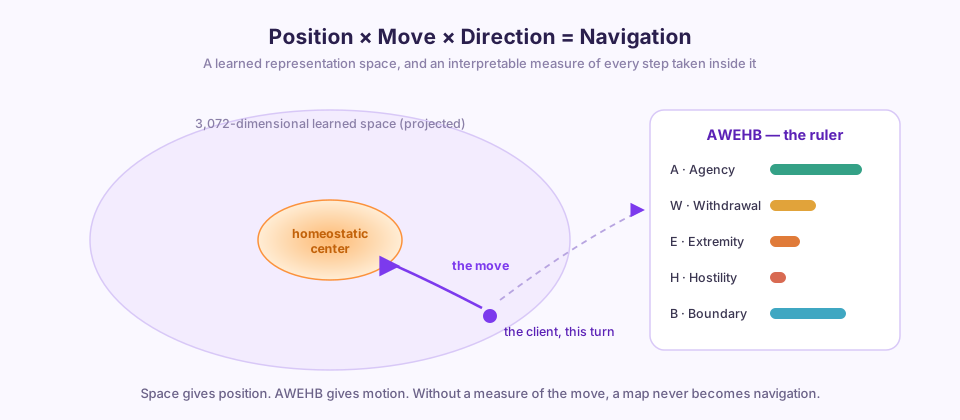
But a space alone is not enough. However precise the map, if you cannot measure whether this step moved closer or farther, it stays a map. AWEHB is what closes that gap: it is the measurement mechanism for the move within the representation space. Each message arrives; five read-outs report the step's direction and magnitude — A and B pulling toward the center, W, E and H pushing away. Position from the learned space, motion from AWEHB, direction from the homeostatic goal: only with all three does a map become navigation, and only then does "guide them toward the orange center" stop being a vision and start being a mechanism that runs on every turn.
There's a quiet irony worth naming. AWEHB's five dimensions are themselves designed — hand-built, symbolic, exactly the kind of thing this essay just argued against. That is deliberate. The representation is connectionist (learned, 3,072 dimensions); the measurement is symbolic (designed, five dimensions, every score explainable) — because a measure must be auditable: "why did W score 2.5" needs an answer a human supervisor can check. A learned space, an interpretable ruler. That hybrid is Hamo's standing position in one sentence: models supply the reading, deterministic structure holds the rules.
Six months from three sentences to an open repository. The space keeps growing with every conversation, and the ruler that measures movement inside it is now something anyone can download. Symbolic boxes go stale; a learned space doesn't — because like the minds it describes, it never stops learning.
Hamo AI — making minds aware, and awake.
About Hamo AI
Hamo AI Technology Ltd. is a Canada-based artificial intelligence company building next-generation AI-Powered Therapist Avatar System. We are developing a comprehensive AI therapy platform called “Hamo” that connects mental health professionals with clients through AI-powered therapy avatars. The ecosystem consists of three interconnected applications: Hamo Pro (therapist dashboard for creating and managing AI avatars), Hamo Client (client interface for interacting with therapy avatars), and Hamo-UME (Unified Mind Engine, backend API). The platform aims to make mental health support more accessible while maintaining professional oversight through professional therapists who create and manage the AI avatars.
Media Contact
Hamo AI Technology Ltd.
Email: socialmedia@hamo.ai
Website: www.hamo.ai
Address: 108 College St, Schwartz Reisman Campus, SUITE W640, Toronto ON M5G 0C6, Canada
Frequently Asked Questions
What is AWEHB? Is it a diagnosis?
AWEHB is five per-message read-outs — Agency, Withdrawal, Extremity, Hostility, Boundary — that describe the direction of a conversation's current step, not the person. It is not a diagnosis, not a clinical assessment, and not a score of anyone's worth. Inside the product it is framed exactly that way: a snapshot read from recent conversations, never a verdict, and the client always has the last word on whether it fits.
Why not use a typing system like MBTI?
Type dichotomies are symbolic priors: a fixed set of hand-designed categories decided before ever meeting you. They are useful vocabulary, but they carry two structural ceilings — they snap continuous people into discrete boxes, and they pin a moving person to a static label. The Enneagram is a fair exception to that second charge: wings, integration and disintegration directions, and nine developmental levels build movement into it. Our difference with it is not static-versus-dynamic but designed-in-advance versus read-from-language. Hamo's representation is learned instead of designed: every conversation updates a high-dimensional vector representation, so the picture is continuous, dynamic, and doesn't need a box to put you in. AWEHB then measures movement within that space — something a static type can't do by construction.
Where do the five dimensions come from?
AWEHB is a formative composite index, not a lift from any single published scale and not a psychometric construct — the five signals are causes of stress rather than five manifestations of one latent variable, which is why there is no Cronbach's alpha or factor loading to inspect. Each dimension stands on established ground — Agency on self-efficacy (Bandura, 1977) and self-determination theory (Deci & Ryan, 1985), Withdrawal on behavioural activation (Ferster, 1973; Lewinsohn, 1974) and learned helplessness (Seligman & Maier, 1967), Extremity on the all-or-nothing pattern from cognitive distortion research, Hostility on classic hostility scales, Boundary on interpersonal-effectiveness work. Validation against an external criterion has not been done yet: our agreement figures are reliability evidence, not validity evidence — and the combination, including its deliberate asymmetry between stress-raising and stress-lowering dimensions, is our own design, documented in our technical whitepaper.
Are my conversations used to train these models?
No. External client conversations never enter any training set — that rule predates the architecture and shaped every decision after it. Real production data serves as a held-out exam only. (Since v6.1, a small consented set from three company-internal staff members also enters training; external client data still never does — see the model card.)
Is the scoring model really open source? Can I use it?
Yes — hamo-score-0.6b is published on Hugging Face with open weights in MLX and GGUF formats, a model card that documents the full teaching chain and data policy, and a license described on the card. It runs locally on modest hardware, which is the point: a clinic or research group can operate its own pulse-taker inside its own compliance boundary, with no cloud dependency.
Does AWEHB decide how the AI treats me?
AWEHB informs; deterministic code decides. The read-outs feed a rules layer we call the spine — it gates how deep a conversation may go and keeps safety behaviors deterministic rather than model-improvised. Crisis handling in particular is never gated on any model's score alone, and the human therapist who created the companion supervises the record.